
ATI Questions > RN Respiratory System | Posted by Cleveland on May 3, 2026
Question:
A nurse is caring for a child in a pediatric clinic.
1400: Child seen for lethargy, fever, cough, poor fluid intake. Tachypneic with adventitious lung sounds, clear nasal drainage. History of asthma; last albuterol dose 1 hr ago.
1420: WBC 7,800. Influenza A positive. Other viral tests negative.
1430: CXR shows bilateral lower lobe opacities.
1445: Preparing for inpatient transfer.
1630: Admitted with pneumonia. Lethargic but responsive. Crying without tears, no urine in hours, refusing fluids. Vitals: T 38.6°C, HR 140, RR 28, BP 92/49, O₂ 92%.
Which of the following prescriptions should the nurse anticipate for the child?Select all that apply.
IV oseltamivir
Antipyretics
Supplemental oxygen
IV fluid for hydration
Droplet isolation precautions
IV ceftriaxone
Answer:


Question:
A nurse is caring for an infant in a pediatric hospital who was diagnosed with Cystic Fibrosis.
Prenatal and newborn screening both Positive for CF
Sweat test was elevated. WBC-High; Hgb, Iron, & Albumin low.
Select the 4 statements that indicate the teaching was effective for new diagnosis of cystic fibrosis
"Our baby's medications can cause growth delays."
"Our baby will take oral enzyme supplements with feedings."
"We will avoid exercise that causes our baby's respiratory rate to increase."
"We will thoroughly clean our baby's reusable suction equipment."
"Our baby will need to consume more calories than other kids their age."
"We will decline annual influenza immunizations for our baby."
Answer:

Question:
A nurse is caring for a 4 y/o child who was diagnosed with acute asthma exacerbation and is demonstrating tachypnea and the use of accessory muscles. Which of the following interventions should the nurse implement to resolve the respiratory manifestations?
Intravenous hydration
Analgesic
Bronchodilator
Antibiotic
Answer:

Question:
A nurse is assessing a 4 y/o child who has upper respiratory infection manis. The nurse suspects epiglottis based on which of the following manifestations? Select All That Apply
Drooling
Stridor on inspiration
Nasal discharge
Sitting in a tripod position
Crackles in lungs
Answer:

Question:
A nurse is providing education to the caregivers of a school aged child about the causes and prevention of Haemophilus influenzae type B (Hib) pneumonia. Which of the following statements indicates an understanding of the teaching?
"This type of pneumonia is prevented by a vaccine."
"This type of pneumonia is caused by aspirating secretions."
"This type of pneumonia is prevented by penicillin-type antibiotics."
"This type of pneumonia can be prevented by decreasing exposure to cold temperatures."
Answer:
"This type of pneumonia is prevented by a vaccine."

Question:
A nurse is providing discharge teaching about RSV infection to the caregivers of a newborn because the newborn was born in January. Which of the following statements by the parent indicates an understanding of the teaching?
"Because our newborn isn't premature, they are not at risk for RSV."
"We will not take our newborn to a restaurant until spring."
"We will require any family members who have symptoms of a respiratory infection to wear a mask while visiting."
"RSV should not be a concern for my newborn because I am breastfeeding."
Answer:
"We will not take our newborn to a restaurant until spring."

Question:
A nurse is providing teaching to the caregivers of a newborn about the differences between the respiratory anatomy of newborns and adults. Which of the following statements indicates the caregivers understand the teaching?
"Because a newborn's nasal cavities are smaller than an adult's nasal cavities, there is an elevated risk for aspiration."
"Newborns' airways are narrower than that of an adult, so there is an increased risk for aspiration."
"Newborns and young children have a shorter trachea which increases the risk for aspiration."
"The muscles in between a newborn's ribs are weaker due to their age, which increases the risk for aspiration."
Answer:
Newborns and young children have a shorter trachea which increases the risk for aspiration


Question:
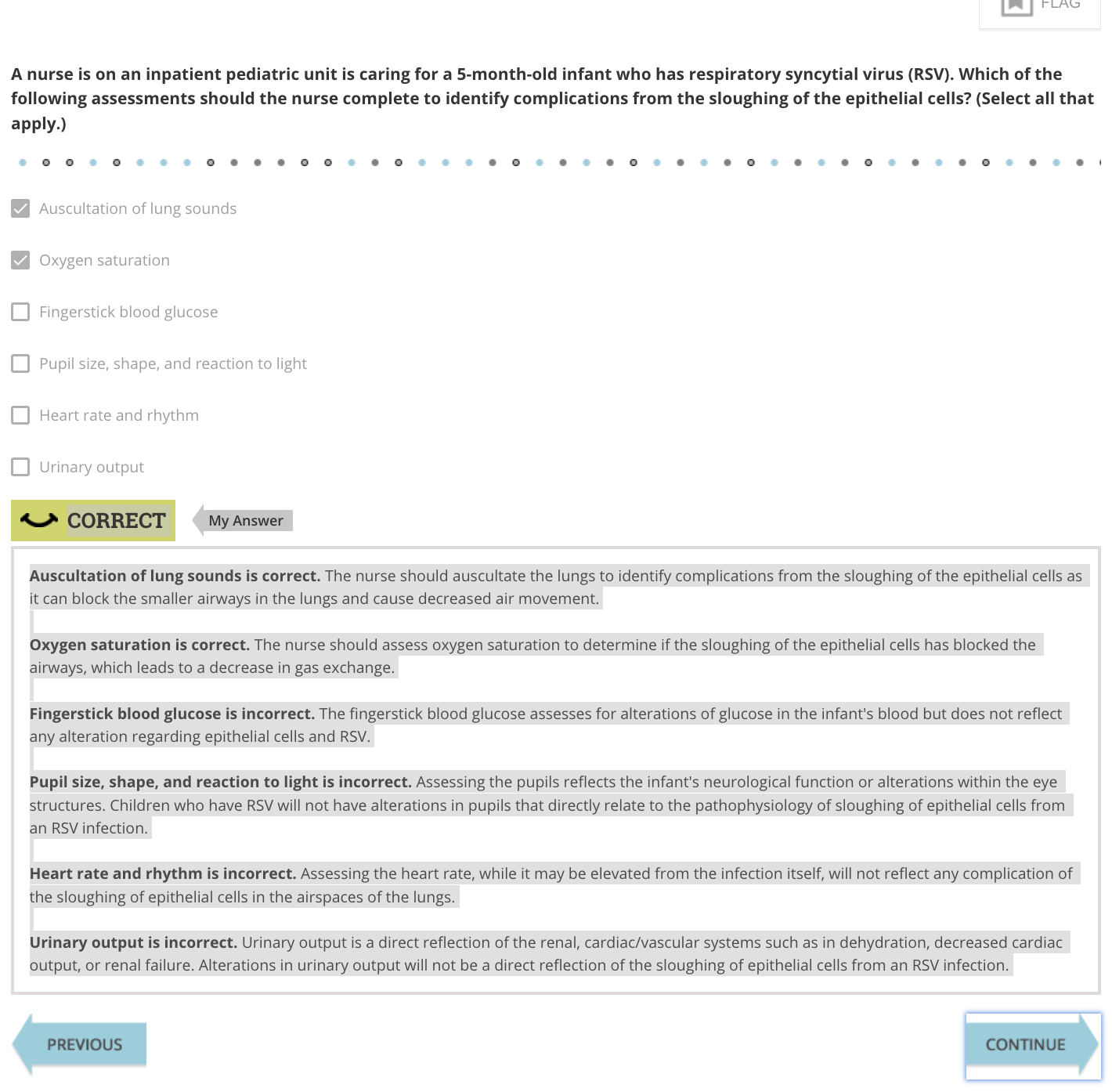
A nurse is on an inpatient pediatric unit is caring for a 5-month-old infant who has respiratory syncytial virus (RSV). Which of the following assessments should the nurse complete to identify complications from the sloughing of the epithelial cells? (Select all that apply.)
Auscultation of lung sounds
Oxygen saturation
Fingerstick blood glucose
Pupil size, shape, and reaction to light
Heart rate and rhythm
Urinary output
Answer:
Question:
A nurse is teaching a group of school aged children about avoiding the spread of germs to their classmates when they have a respiratory illness. Which of the following responses by one of the children demonstrates an understanding of the teaching?
"Washing my hands before class, after the bathroom, and before lunch will help."
"Covering my nose and mouth with my elbow when sneezing will help."
"I should wear a mask if others in the class are sick."
"Using hand sanitizer every hour will help prevent the spread of germs."
Answer:
"Covering my nose and mouth with my elbow when sneezing will help."

Question:
A nurse is planning care for a toddler who has influenza. Which of the following interventions should the nurse include in the plan? Select all that Apply
Implement droplet precautions.
Administer suction to the nares.
Encourage the parent to have the toddler vaccinated for influenza.
Place a tracheostomy set at the bedside.
Administer rifampin 1 hr prior to a meal.
Answer:

Question:
A nurse in the inpatient facility is caring for a 5-year-old patient who has bronchitis. Place the planned interventions in order of highest priority to lowest priority.
Administrator IBU if child reports pain for 5 on 0-10 scale.
Apply Oxygen via nasal cannula
Insert PIV and shart NS at 10/mL/kg/hr.
Provide age-appropriate toys and books
Answer:

Question:
A nurse is providing teaching to the caregiver of a 10-year-old child who is newly diagnosed with pertussis and is being admitted to the pediatric unit. Which of the following statements should the nurse include in the teaching? (Select all that apply.)
"Wear a surgical mask while in the room with the child."
"Children normally maintain good school attendance."
"We will report this infection to the health department."
"People around you may need the pertussis vaccine."
"Isolate from others until taking antibiotics for 24 hours."
Answer:

Question:
A nurse is providing care for a 2 y/o who has croup like manifestations. Based on the child's developmental level, the nurse would adapt care by completing which of the following interventions?
-Offer for the toddler to sit with the caregiver or on the exam table for assessments.
-Give any injections without warning to avoid protest.
-Have the toddler's caregiver wait outside the room during any painful procedures.
-Have the toddler pour the liquid medicine into the cup.
Answer:
-Offer for the toddler to sit with the caregiver or on the exam table for assessments.

Question:
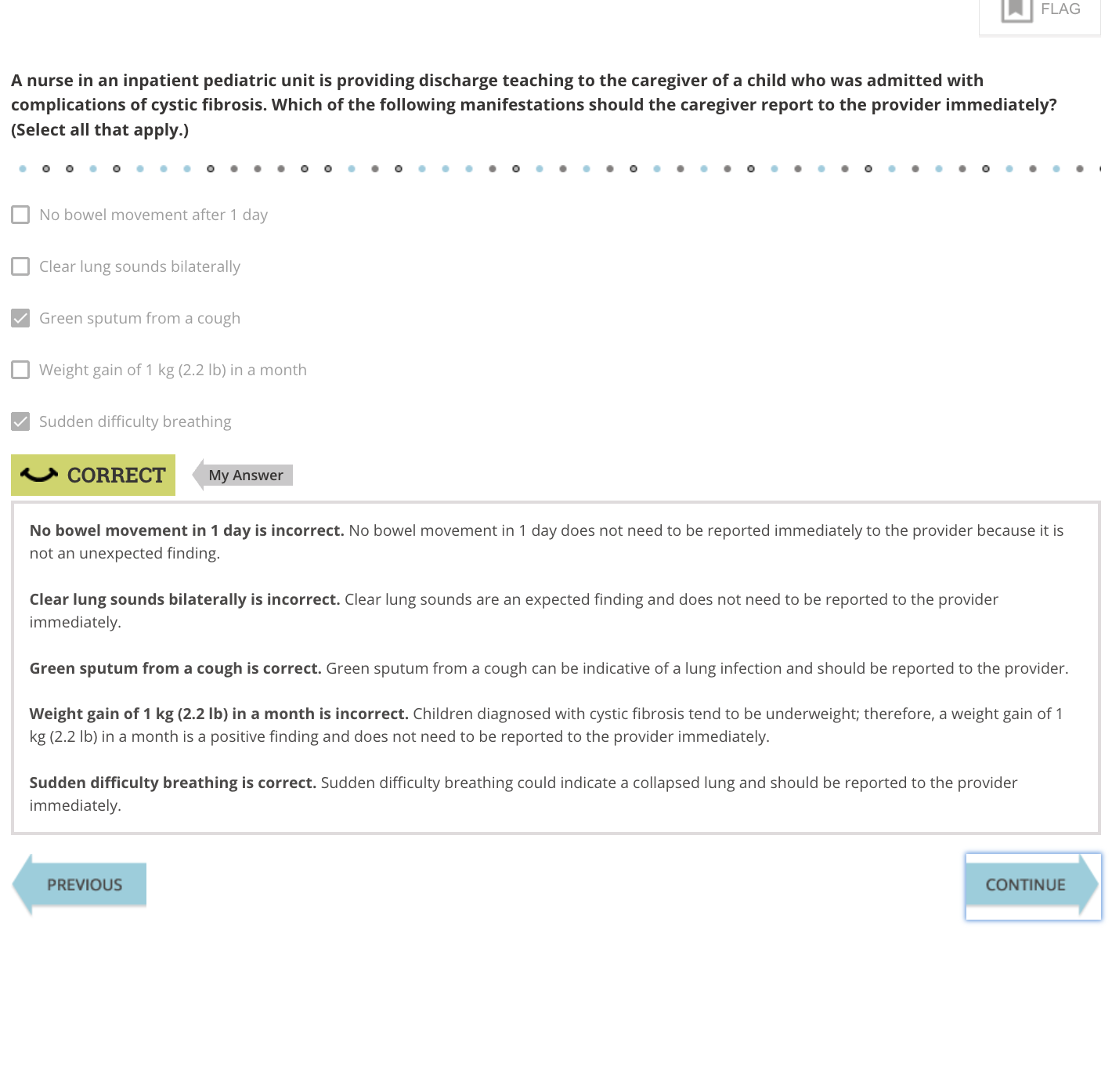
A nurse in an inpatient pediatric unit is providing discharge teaching to the caregiver of a cild who was admitted with complications of cystic fibrosis.Which of the following manifestations should the caregiver report to the provider immediately?
-No bowel movement after 1 day
-Clear lung sounds bilaterally
-Green sputum from a cough
-Weight gain of 1kg(2.2lb) in a month
-Sudden difficulty breathing
Answer:
Question:
A nurse is teaching the caregiver of a school age child about respiratory infections during the fall season. Which of the following causes of respiratory infections should the nurse include in the teaching?
Colder temperatures
Children returning to school
Staying inside playing video games
Misuse of antibiotics for previous respiratory infections
Answer:
Children returning to school

Question:
A nurse is planning care for a 2-month-old infant who has respiratory syncytial virus (RSV). Which of the following interventions should the nurse include the plan of care? (Select all that apply.)
Keep the nasal passages clear to allow the infant to use a pacifier.
Allow self-soothing when the infant cries.
Encourage the caregivers to rock or hold the infant when they are upset.
Place the 2-month-old infant on their stomach in the crib while sleeping to aid in drainage.
Switch the infant to bottle feeding while in the facility.
Answer:

Question:
A nurse is caring for a 9 y/o who was admitted to a ped unit with a diagnosis of asthma exacerbation. upon assessment, the child is calm with even respirations, no use of accessory muscles, and has a RR of 16/min. Mild wheezing noted in the left lower lobe, other lobes clear. Which of the following meds should the nurse anticipate administering?
Penicillin
Albuterol
Ibuprofen
Formoterol
Answer:
Formoterol

Question:
A nurse is called to a 14-year-old client's room because their caregiver believes they have food lodged in their throat. Which of the following manifestations indicates that the adolescent is aspirating on a food item? (Select all that apply.)
The client tells the nurse the last item they ate.
The nurse hears stridor from the client's airway.
The nurse notes a moderate amount of drooling from the mouth.
The client's respiratory rate is 18/min and their skin color is consistent with their genetic background.
The client has a weak cough and is grabbing at the front of their neck.
Answer:

Question:
A nurse in a pediatric clinic is gathering information about a 12-year-old client. Which of the following should the nurse recognize as a manifestation of cystic fibrosis (CF)? (Select all that apply.)
Steatorrhea
High BMI
Absence of manifestations of puberty
Height is average for their age
Constipation
Answer:

Question:
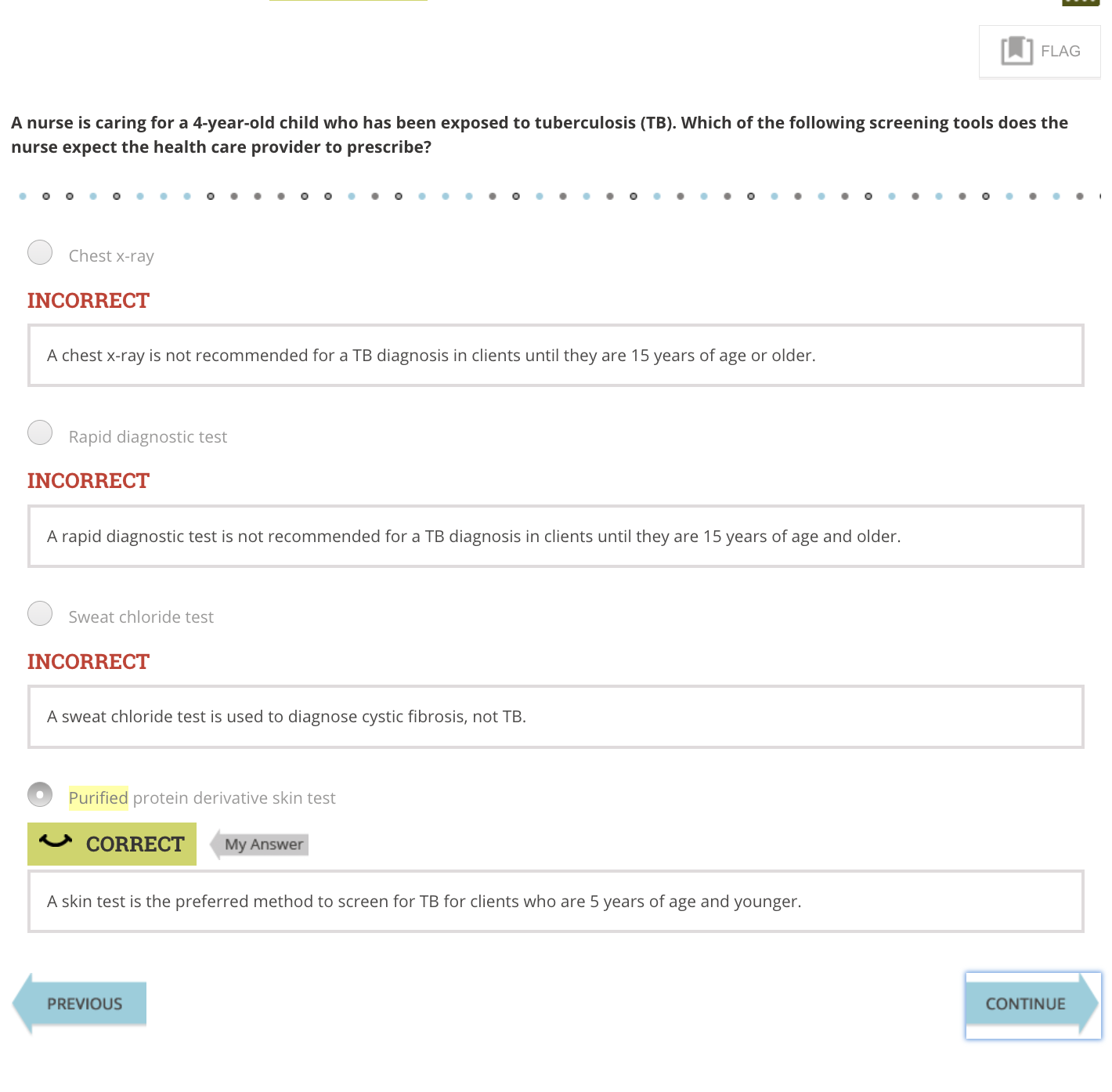
A nurse is caring for a 4-year-old child who has been exposed to Tuberculosis (TB). Which of the following screening tools does the nurse expect the provider to prescribe?
Chest x-ray
Rapid diagnostic test
Sweat chloride test
Purified protein derivative skin test
Answer:
Purified protein derivative skin test
Question:
A nurse in an inpatient pediatric unit is caring for a 9-month old infant who has cystic fibrosis. Which of the following findings indicate the infant is adapting to the admission to the unit
Takes in 15% of the food offered
Excessive crying when a caregiver changes diaper
Poor eye contact with visiting family
Sleeps 8hr overnigh
Answer:
sleeps 8 hrs overnight

Question:
A nurse is caring for an 18-month-old toddler in an urgent care clinic.
1200: Presents with URI x2 days. Cough worse overnight with 102 fever. Mild prolonged expiratory wheezes upon auscultation, mucous membranes pink/moist, mild flaring, and subcostal retractions noted. Moderate thick, yellow nasal drainage. Tyl given PO for fever. T 101.2, RR 28, HR 120, O2 96% RA
1245: WBC, Neutrophils, Lymphocytes, monocytes, and basophils WNL; Eosinophils elevated. RSV Positive, Rhinovirus, Adenoviris, COVID, Influenza A&B Negative.
1300: T 100.8, RR 28, HR 112, O2 94% RA
For each assessment finding, click to specify if the finding is consistent with croup or bronchiolitis. Each finding may support more than 1 disease process or none at all, but each disease must have one selection.
Breath sounds
Temperature
Expiratory phase of respirations
Nasopharyngeal laboratory results
Characteristic of cough
Answer:

Question:
A nurse is admitting a 1-year-old child who has respiratory syncytial virus (RSV). Which of the following interventions should the nurse implement? (Select all that apply.)
Place a sign and personal protective equipment (PPE) for droplet and contact isolation precautions at the client's door.
Set up suction in the room.
Call the provider to request a prescription for a broad-spectrum antibiotic.
Auscultate lung sounds after suctioning.
Bring toys appropriate for the child's developmental age to their room.
Provide education to the caregiver regarding the need for fluids.
Answer:
Place a sign and PPE for droplet and contact isolation precautions at the client's door
Set up suction in the room
Auscultate lung sounds after suctioning
Bring toys appropriate for the child's developmental age to their room
Provide education to the caregiver regarding the need for fluids

Question:
A nurse is caring for an 18-month-old toddler in an urgent care clinic.
1200: Presents with URI x2 days. Cough worse overnight with 102 fever. Mild prolonged expiratory wheezes upon auscultation, mucous membranes pink/moist, mild flaring, and subcostal retractions noted. Moderate thick, yellow nasal drainage. Tyl given PO for fever. T 101.2, RR 28, HR 120, O2 96% RA
1245: WBC, Neutrophils, Lymphocytes, monocytes, and basophils WNL; Eosinophils elevated. RSV Positive, Rhinovirus, Adenoviris, COVID, Influenza A&B Negative.
1300: T 100.8, RR 28, HR 112, O2 94% RA
For each assessment finding, click to specify if the finding is consistent with croup or bronchiolitis. Each finding may support more than 1 disease process or none at all, but each disease must have one selection.
Breath sounds
Temperature
Expiratory phase of respirations
Nasopharyngeal laboratory results
Characteristic of cough
Answer:
