
ATI Questions > RN Gastrointestinal System Assessment | Posted by Cleveland on May 18, 2026
Question:
A nurse is caring for a child who has abdominal pain.
This visit:
Child is admitted to the inpatient pediatric department with reports of abdominal pain localized to the right lower quadrant. Rebound tenderness in the right lower quadrant. Positive Rovsing's sign. Onset of pain 20 hr ago, worsening over time. No significant medical or family history reported by family or child. No medications. Lives with parents and younger sibling and attends elementary school. Mild nausea, no vomiting.
For each potential provider's prescription, click to specify if the potential prescription is anticipated or contraindicated for the client. There must be at least 1 selection in every row. There does not need to be a selection in every column.
Answer:
Anticipated:
IV antibiotics
Analgesics for pain
IV fluids
Contraindicated:
Liquid diet
Laxative
Heat to the abdomen

Question:
A nurse is caring for an 8 month of infant brought into the emergency department.
The visit:
Infant is brought to the pediatric ED by their caregivers due to persistent, severe abdominal pain. Infant has no previous medical history. Caregivers report that the infant has been inconsolable and drawing their legs to their abdomen. Infant has had intermittent episodes of vomiting, and their caregivers have noticed "currant jelly-like" stools.
Complete the following sentence by using the list of options.
Answer:

Question:
A nurse is caring for a 4 year old child who has vomiting and diarrhea.
This visit:
4-year-old child has a 2-day history of gastroenteritis with vomiting and diarrhea. Child has been unable to tolerate oral intake and decreased urine output with output in today.
Select 3 findings that require a follow-up.
Answer:
Urinary output
Behavior
Capillary refill

Question:
A school nurse is caring for a 6 year old child who has been experiencing constipation. The nurse is explaining to a nursing student that children who has constipation are at an increase risk of psychosocial problems. Which of the following factors contribute to this risk? (Select all that apply)
Answer:
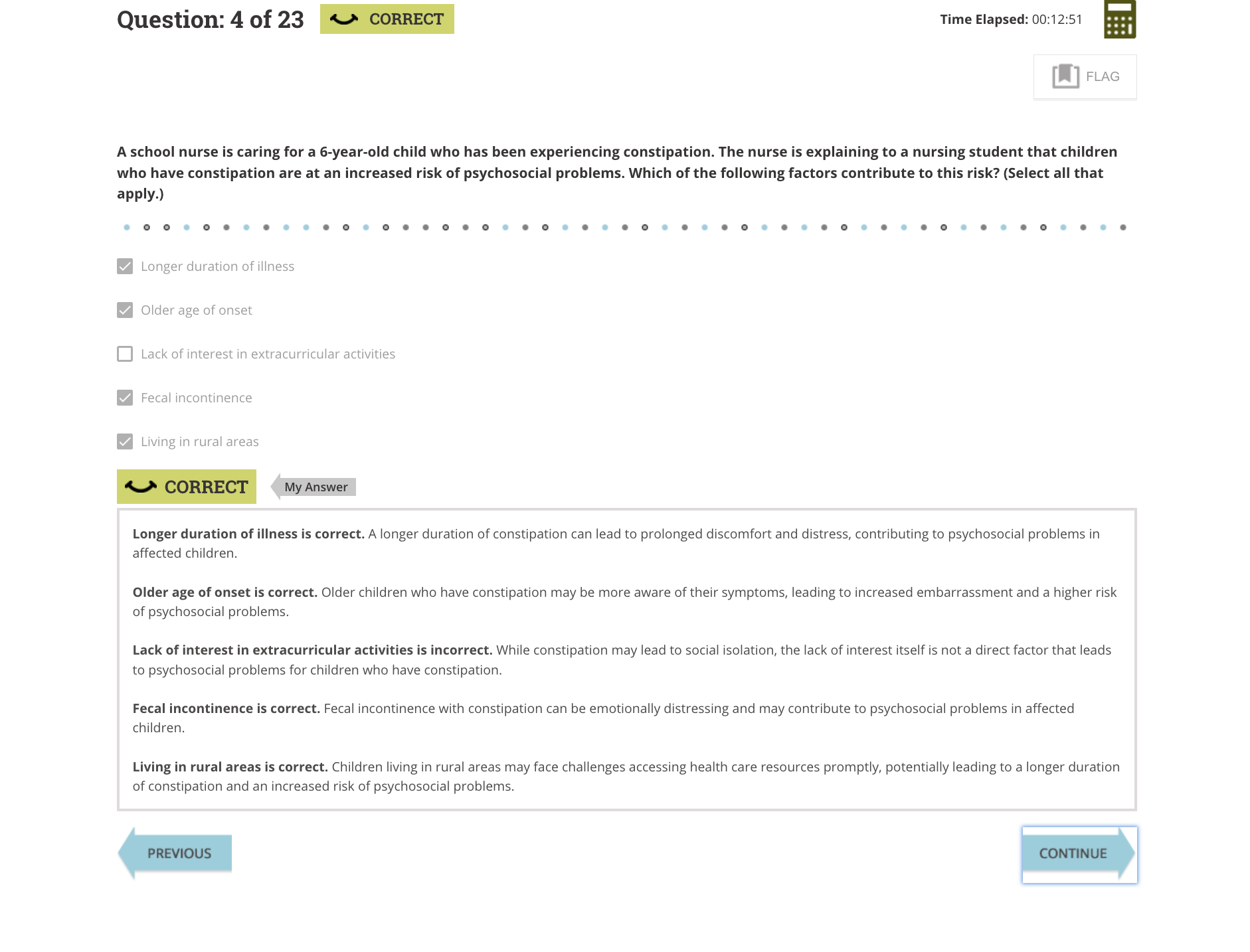
Question:
A nurse is caring for an infant who has cleft lip and cleft palate. Which of the following communication techniques is therapeutic for infants?
Answer:
Maintain a friendly expression and use a soft, calm voice.

Question:
The nurse is providing education for the parents of a 2 month old infant who has gastroesophageal reflux (GER). Which of the following responses should the nurse give to clarify the pathophysiology?
Answer:
GER occurs when muscle at the bottom of the infant's food pipe is weak, causing milk or formula to flow back up.

Question:
A nurse is weighing and measuring a 9 month old infant who has failure to thrive (FTT). The growth chart notes that the growth trajectory falls below the fifth percentile. which of the following is the most likely cause of FTT for an infant?
Answer:
Inadequate nutrition

Question:
A nurse is providing education for the parents of a toddler who experiences frequent vomiting. Which of the following statements accurately describes the potential impact of frequent vomiting?
Answer:

Question:
A nurse is caring for a 3 year old toddler who has a fever and mild dehydration. the parents a concerned that their toddler may also have abdominal pain. Which of the following actions should the nurse take to check for pain in the toddler?
Answer:
Observe for nonverbal cues such as facial expressions and body language.

Question:
A nurse is caring for an infant who has celiac disease. The parents ask the nurse for clarification after the provider explained the pathophysiology to them. Which of the following answers should the nurse provider for the parent?
Answer:
"Celiac disease is an autoimmune disorder resulting for an intolerance to gluten."
Question:
A nurse is caring for a child who has been newly diagnosed with anorexia nervosa. The parent asks the nurse to tell them more about the condition. Which of the following responses should the nurse iniclude?
Answer:
A nurse is caring for a child who has been newly diagnosed with anorexia nervosa. The parent asks the nurse to tell them more about the condition. Which of the following responses should the nurse iniclude?

Question:
Answer:
Dehydration

Question:
A nurse is providing education for the parents of an infant who has pyloric stenosis. Which of the following statements by the parents indicates they understand the underlying cause of pyloric stenosis?
Answer:
"The muscles around the pylorus have become too thick, causing a blockage that leads to vomiting."

Question:
A nurse is conducting a home visit for a 9 month old infant who has failure to thrive. The infant's parent has a full tie job and attends graduate school. the parent suspects the infant may have malabsorption disorder. Which of the following psychosocial risk factors should the nurse identify as a likely contributing factor
Answer:
"Time scarcity."

Question:
An emergency department nurse is caring for a 2 year old toddler who has dehydration due to diarrhea and no past medical history. The toddler presents with lethargy and has not had any urine output in the last 12 hr. Which of the following treatments should the nurse expect the provider to prescribe?
Answer:
IV bolus of 20 mL/kg of 0.9% sodium chloride (normal saline) over 10 to 20 min

Question:
A nurse is caring for a 4 year old preschooler who is vomiting. which of the following statements indicates the guardian understands the most underlying cause of vomiting in children?
Answer:
A nurse is caring for a 4 year old preschooler who is vomiting. which of the following statements indicates the guardian understands the most underlying cause of vomiting in children?

Question:
A nurse is caring for a 1 year old child who has a history of diarrhea for the past 2 days. the child is alert, oriented, and has one wet diaper in the last 6 hr. Which of the following actions is most appropriate for encouraging hydration in this situation?
Answer:
"Providing electrolyte drinks through a syringe,"

Question:
A nurse is providing education to parents of a toddler at a well-child checkup. Which of the following statements should the nurse include when discussing the prevention of food aversion or neophobia in young children?
Answer:
"Introduce new foods to the toddler's diet frequently and encourage tasting."

Question:
A nurse is providing education with the parents of a child who has constipation. The provider has prescribed polyethylene glycol (PEG). Which of the following instructions should the nurse include?
Answer:
"Notify your provider if your child experiences abdominal distension."

Question:
A nurse is providing education for the parents of a newborn who has client palate. The parents express concern about when and how the cleft plate occurred. Which of the following response by the nurse is correct?
Answer:
"Cleft palate is the incomplete fusion of the roof of the mouth during the sixth or seventh week of gestation."

Question:
A nurse is providing eduation to the parents of a 6-year-old child who has gastroesophageal reflux disease (GERD). Which of the following statements by the parent indicates a need for further teaching?
Answer:
A nurse is providing eduation to the parents of a 6-year-old child who has gastroesophageal reflux disease (GERD). Which of the following statements by the parent indicates a need for further teaching?

Question:
A nurse is caring for a newborn who has a cleft lip. Which of the following statements by the parents indicates a need for further teaching regarding the management of cleft lip?
Answer:

Question:
A nurse is collaborating with a nursing student in caring for a 3-year-old toddler who has onset of feeding issues. Which of the following statements should the nurse give when the students asks about leaking causes of feeding issues in toddlers?
Answer:
