Anatomy and Physiology > Nursing Papers | Posted by Cleveland on April 10, 2026
Question:
A nurse is caring for a client who is being evaluated for obstructive sleep apnea. Which of the following findings should the nurse identify as a risk factor for obstructive sleep apnea?
Hypersomnia
Obesity
Active glossal muscle
History of tonsillectomy
Answer:
Obesity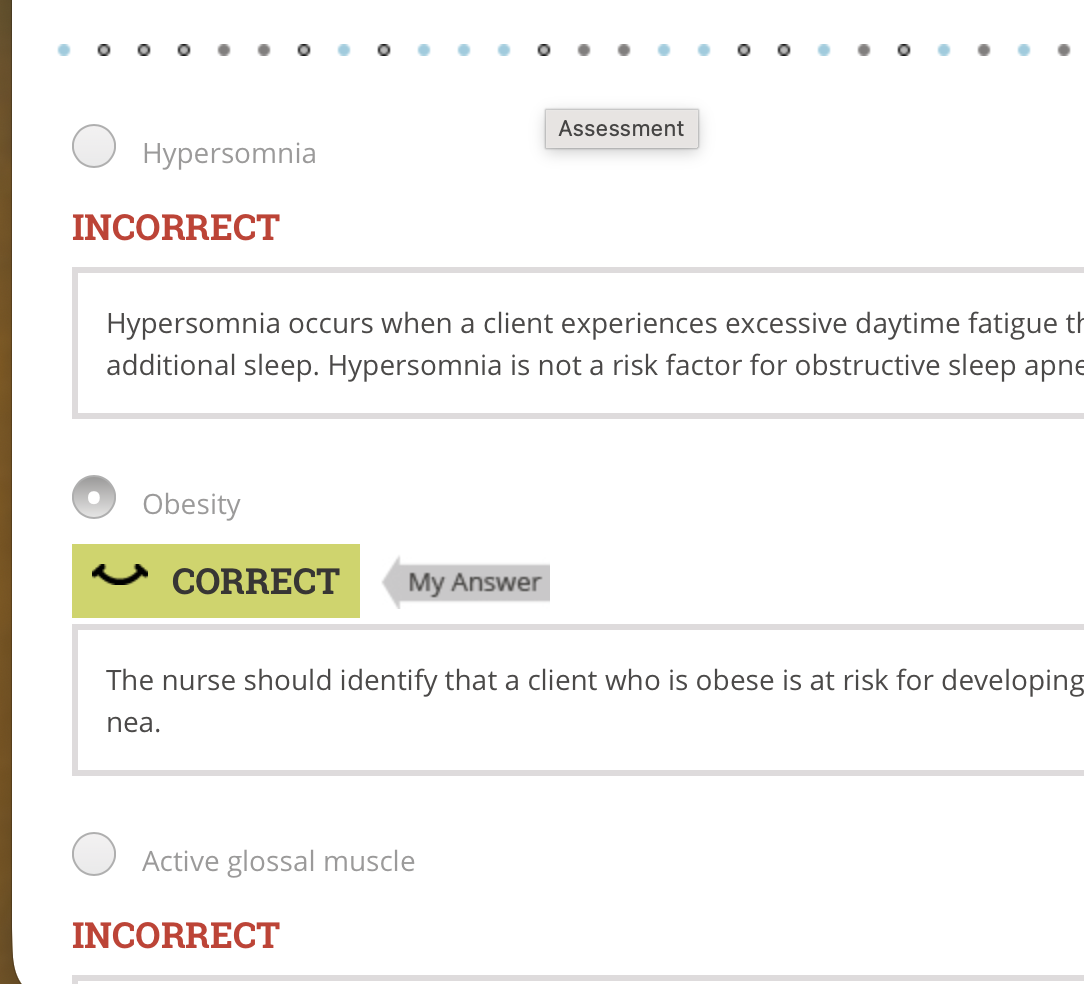
Question:
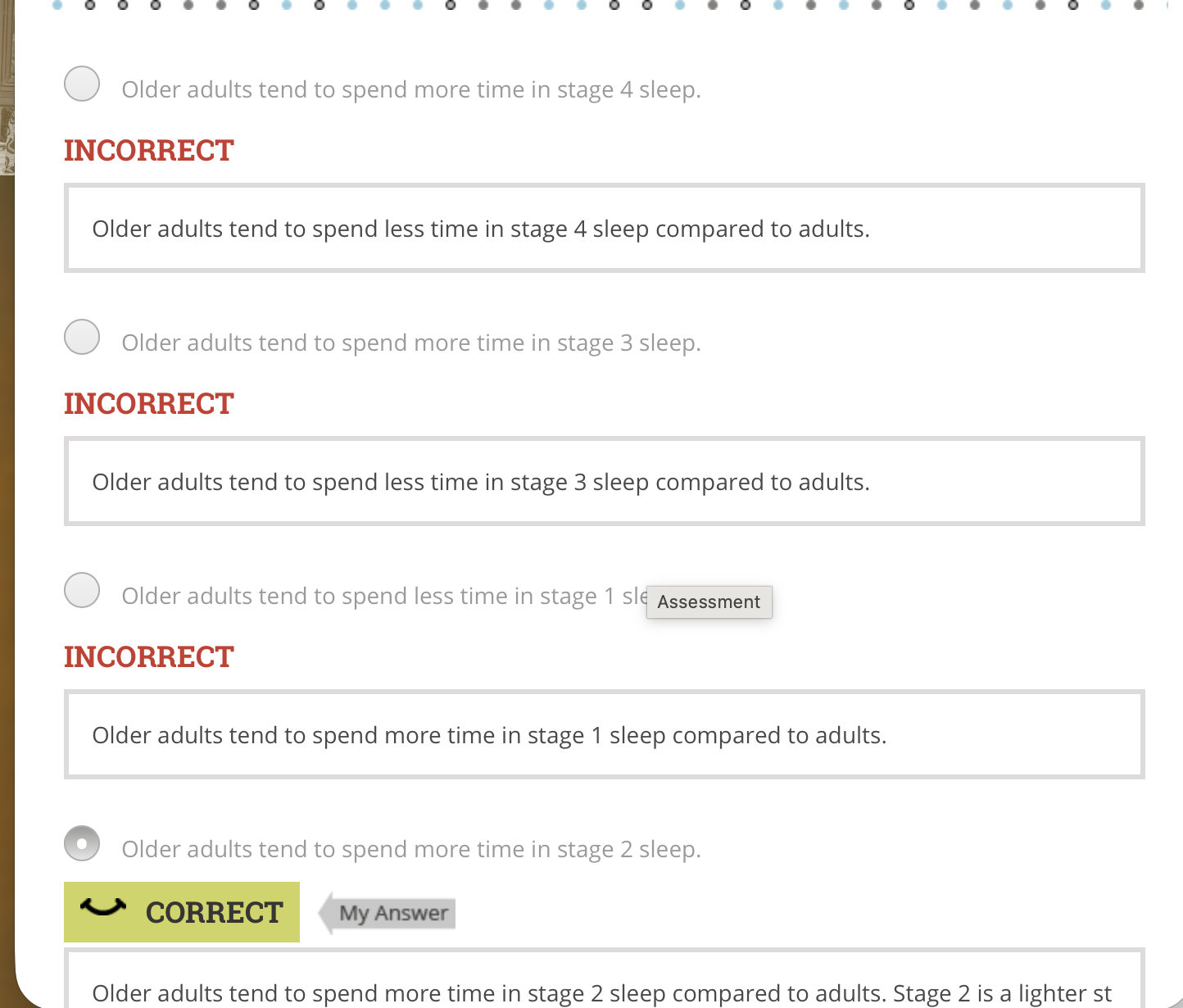
A nurse is caring for an older adult client who reports that they wake up f requently during the night. The nurse should identify that which of the fo Ilowing is a characteristic of older adult sleep patterns that might explain the client's frequent awakenings?
Older adults tend to spend more time in stage 4 sleep.
Older adults tend to spend more time in stage 3 sleep.
Older adults tend to spend less time in stage 1 sleep.
Older adults tend to spend more time in stage 2 sleep.
Answer:
Question:
A nurse is caring for a client who has a history of migraines. The client tell s the nurse, "I have not been sleeping well. My migraine headaches have r eturned after not having one for over a year." The nurse should identify t hat which of the following are potential contributing factors to the client' s migraines? (Select all that apply.)
Sleep-wake homeostasis
Assessment
Sensory overload
Sleep deprivation
Increased melatonin
Decreased hypocretin levels
Answer:
he correct answers are:
✅ Sensory overload
✅ Sleep deprivation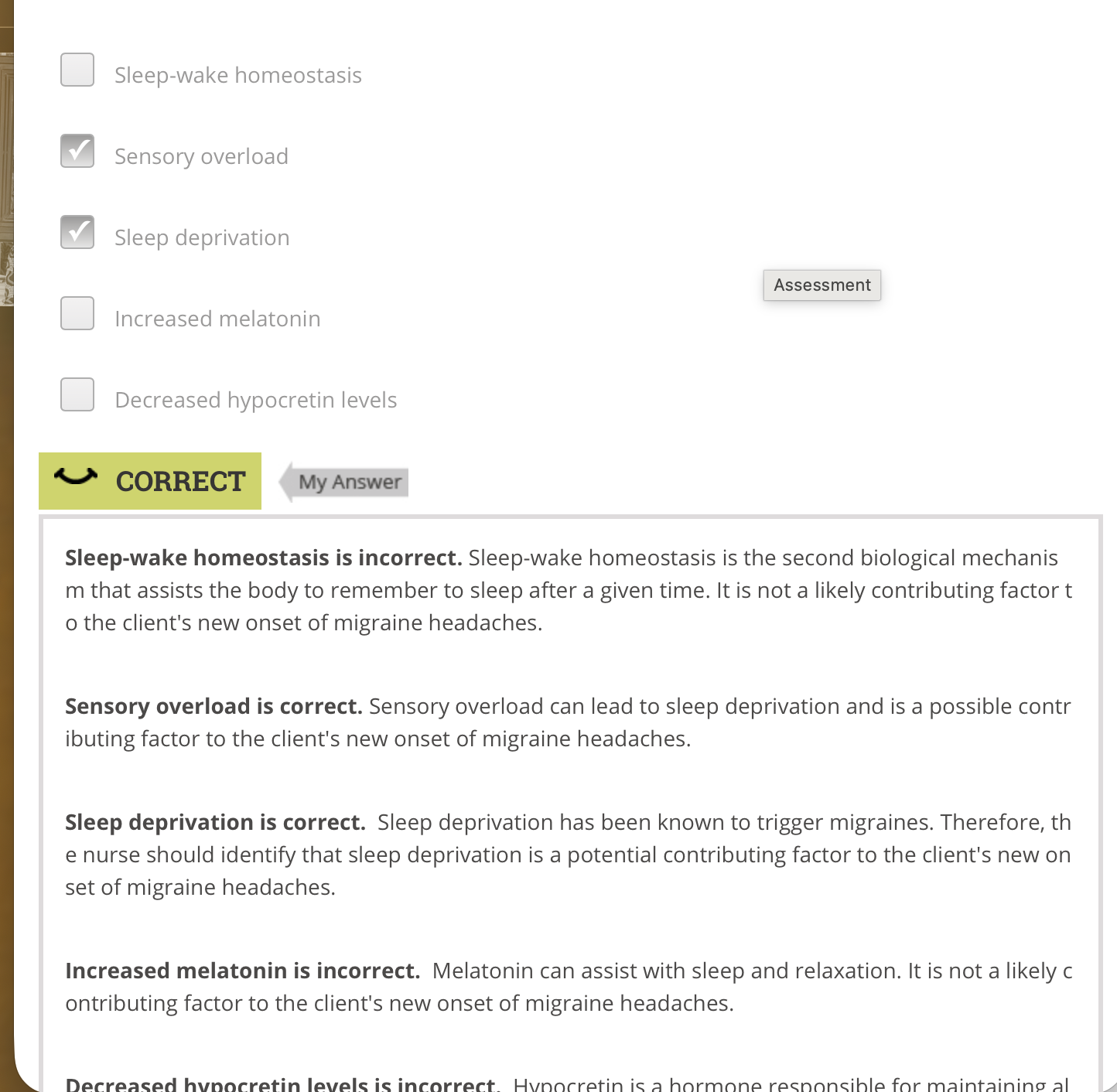
Question:
A nurse is caring for a client who has a new prescription for a nonbenzodi azepine hypnotic to promote sleep. For which of the following adverse eff ects should the nurse monitor the client?
Retrograde amnesia
Urinary discomfort
Assessment
Dry mouth
Hallucinations
Answer:
Hallucinations 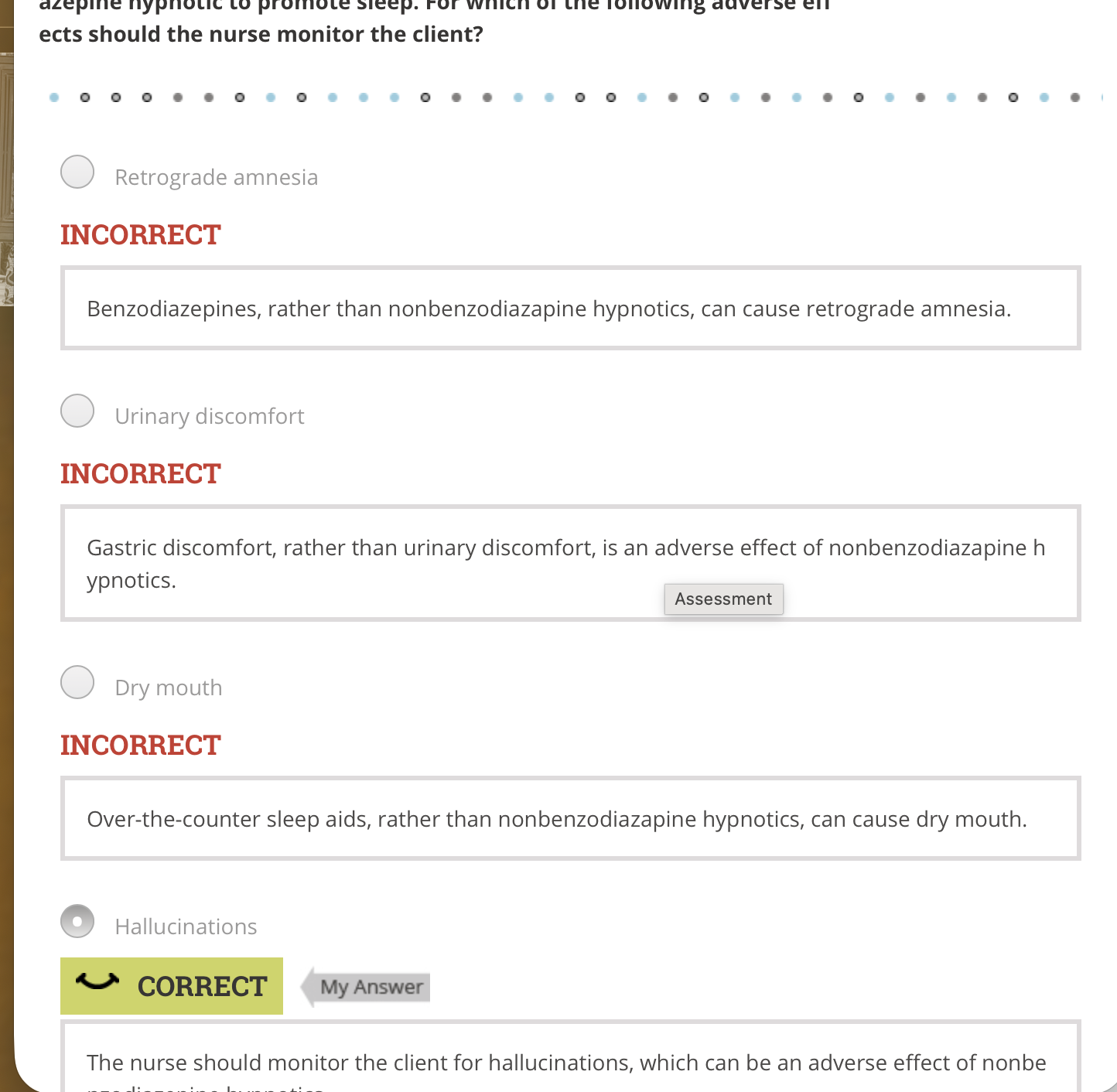
Question:
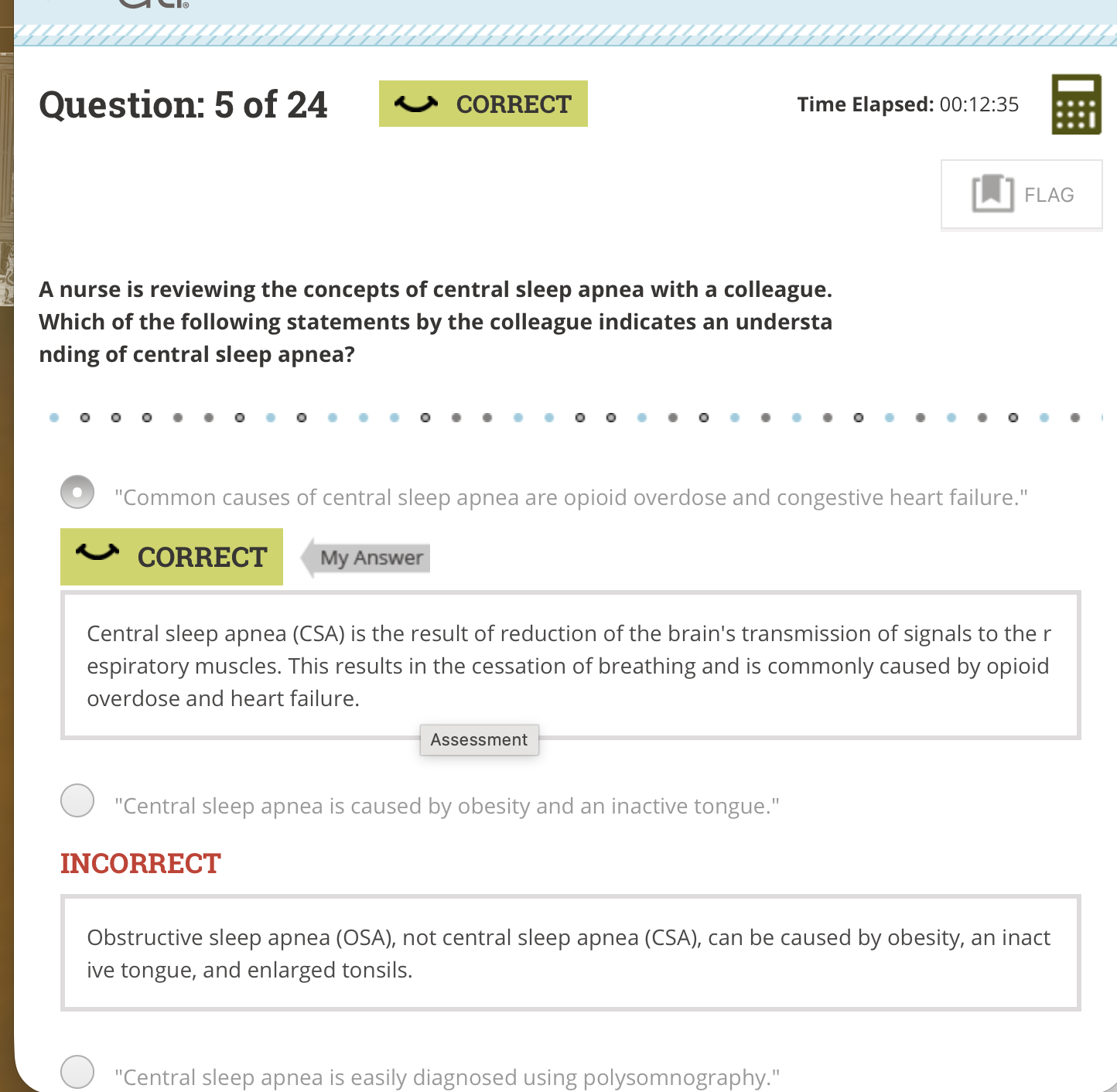
A nurse is reviewing the concepts of central sleep apnea with a colleague.
Which of the following statements by the colleague indicates an understa nding of central sleep apnea?
"Common causes of central sleep apnea are opioid overdose and congestive heart failure."
"Central sleep apnea is caused by obesity and an inactive tongue."
"Central sleep apnea is easily diagnosed using polysomnography."
Assessment
"Central sleep apnea is related to the recurrent episodes of upper airway collapse and obstruction."
Answer:
✅ "Common causes of central sleep apnea are opioid overdose and congestive heart failure." 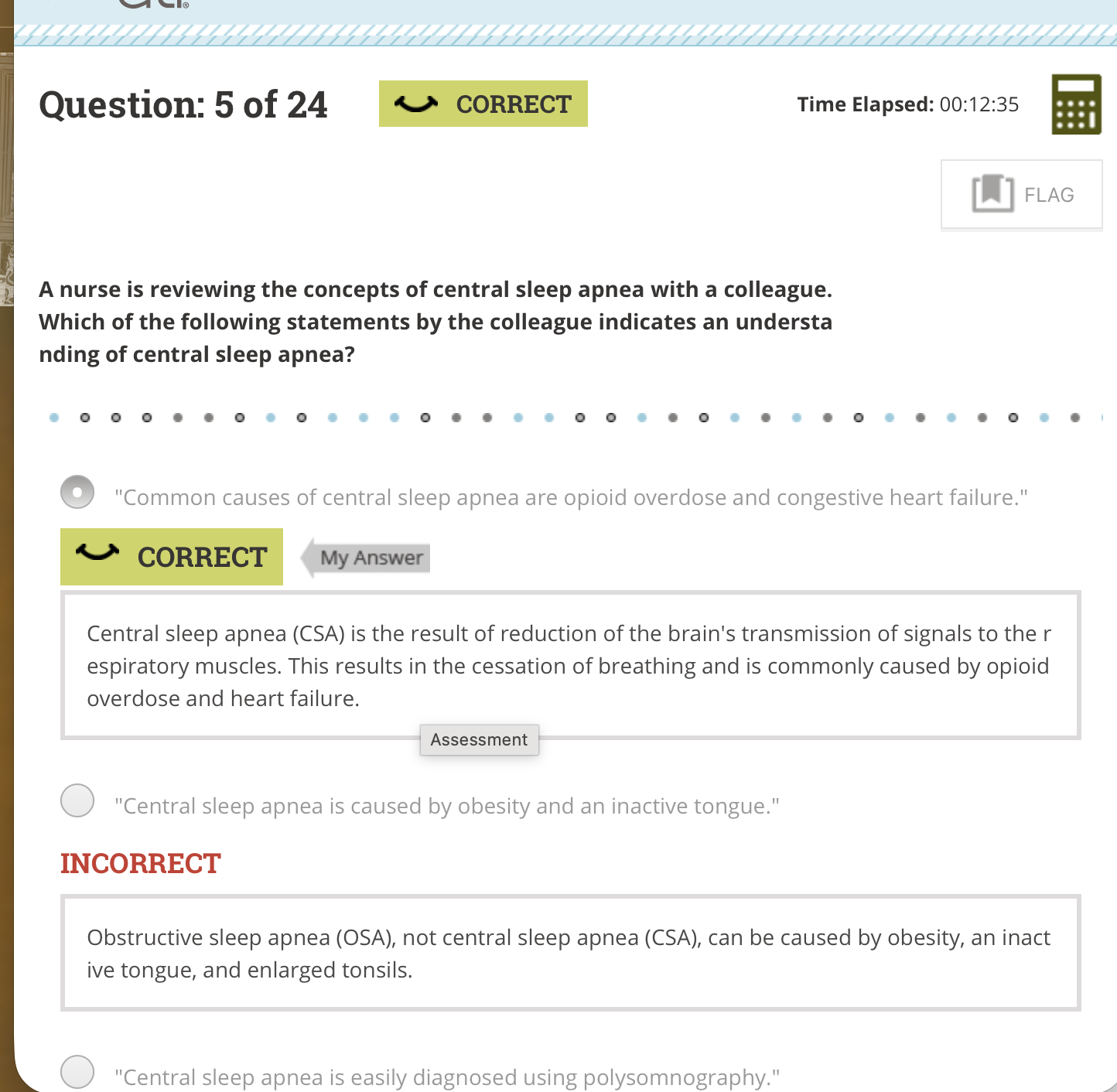
Question:
A nurse is caring for a client who reports that they use their smartphone at night while they are in bed. The nurse should identify that excessive s martphone use can increase the client's risk for which of the following?
• °
Depression
Binge eating disorder
Restless leg syndrome (RLS)
• Diminished circadian rhythm
Answer:
Depression
Question:
A nurse is caring for a client who takes an over-the-counter (OTC) sleep ai d medication every evening. Which of the following findings should the n urse identify as a potential adverse effect of OTC sleep aid medications?
•
Hyperactivity
Diarrhea
Excessive salivation
Assessment
Urinary retention
Answer:
Urinary retention 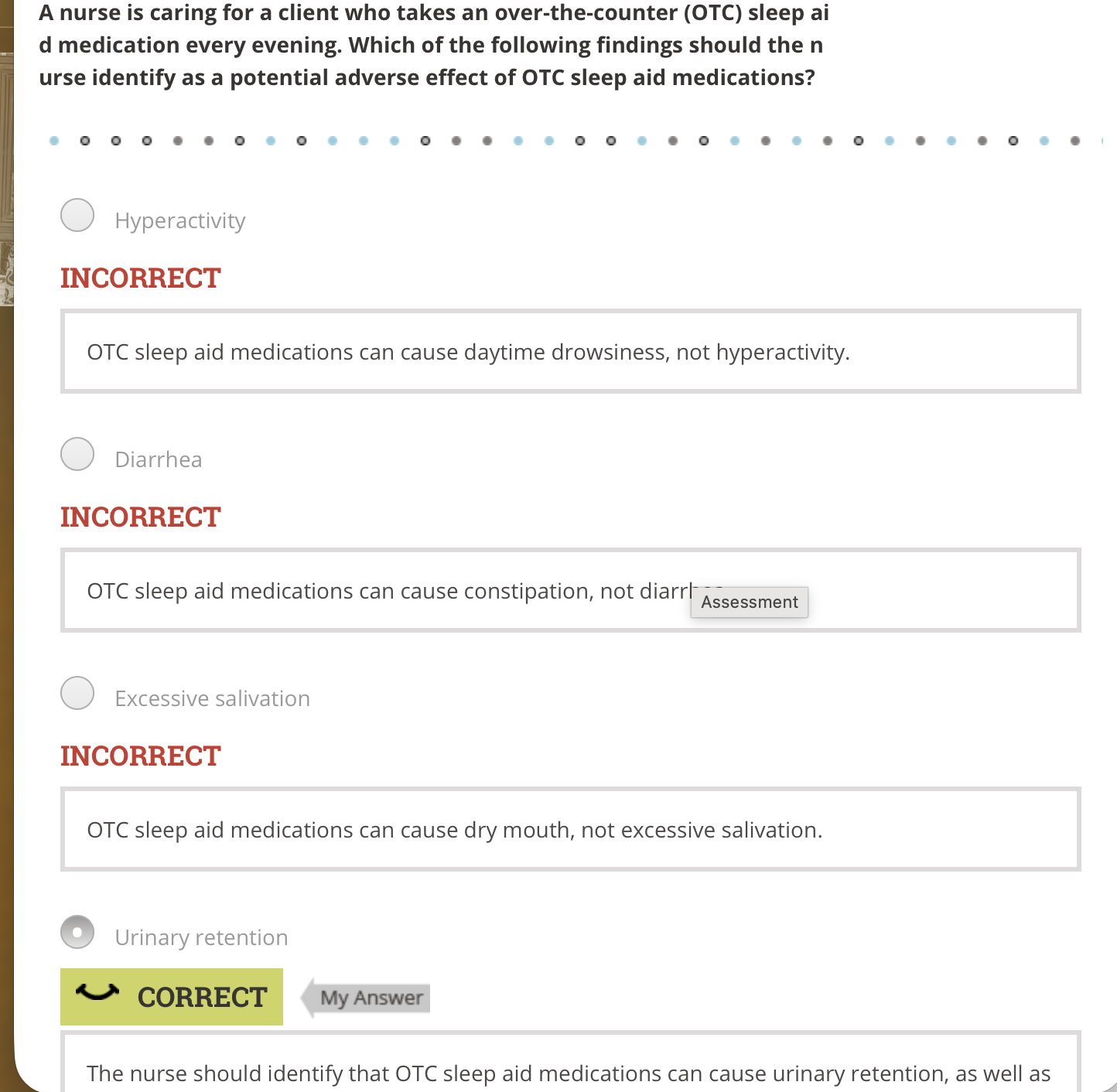
Question:
A nurse is contributing to a presentation about nonpharmacological inter ventions used to promote sleep. Which of the following information shoul d the nurse recommend including in the presentation?
Nonpharmacological interventions should only be practiced in the client's home setting.
Massage is a nonpharmacological intervention that should be used to promote sleep for clien ts who are taking anticoagulants.
Assessment
Nonpharmacological interventions used to help promote sleep include acupuncture and ther motherapy.
Before implementing nonpharmacological interventions, clients should be evaluated by a slee p specialist for sleep apnea and chronic lung disease.
Answer:
Nonpharmacological interventions used to help promote sleep include acupuncture and thermotherapy.”
Question:
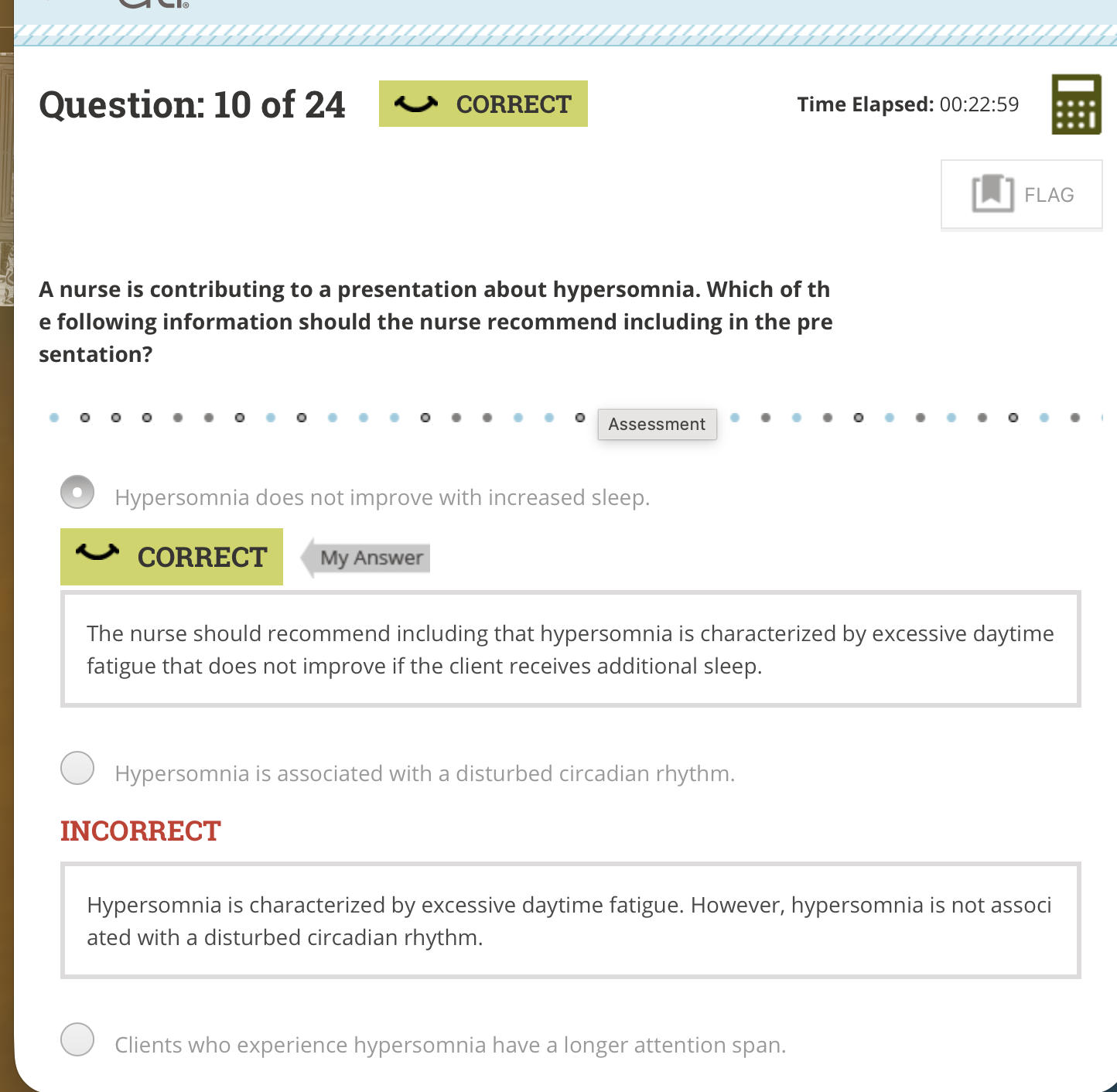
A nurse is contributing to a presentation about hypersomnia. Which of th e following information should the nurse recommend including in the pre sentation?
Hypersomnia does not improve with increased sleep.
Hypersomnia is associated with a disturbed circadian rhythm.
Clients who experience hypersomnia have a longer attention span.
Clients who experience hypersomnia lack the hormone hypocretin.
Answer:
Hypersomnia does not improve with increased sleep.
Question:
A nurse is teaching a newly licensed nurse about the development of drea ms. The nurse should include that which of the following areas of the brai n transmits the sensory data that is used to develop dreams?
• °
Hypothalamus
Thalamus
Cerebral cortex
Assessment
• Pineal gland
Answer:
Thalamus 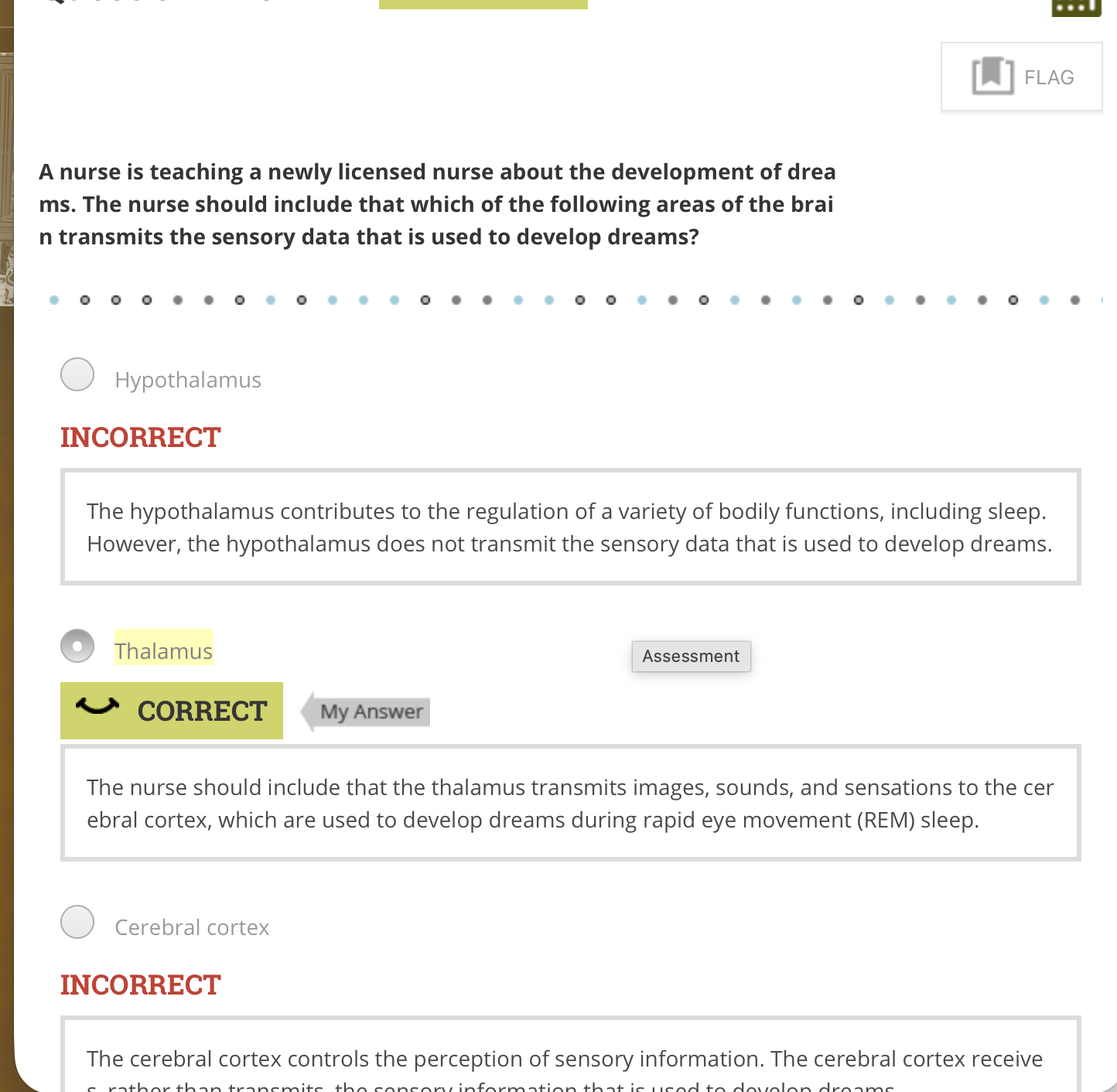
Question:
A nurse is caring for a client who needs to be awakened for the administr ation of an oral medication. Which of the following findings should indica te to the nurse that the client was in stage 3 of the sleep cycle when awak ened?
The client was easily awakened.
The client states that they were having a pleasant dream.
The client experiences mental cloudiness for 30 to 60 min.
Prior to being awakened, the client's breathing was irregular and their heart rate was elevate
Answer:
✅ The client experiences mental cloudiness for 30 to 60 min. 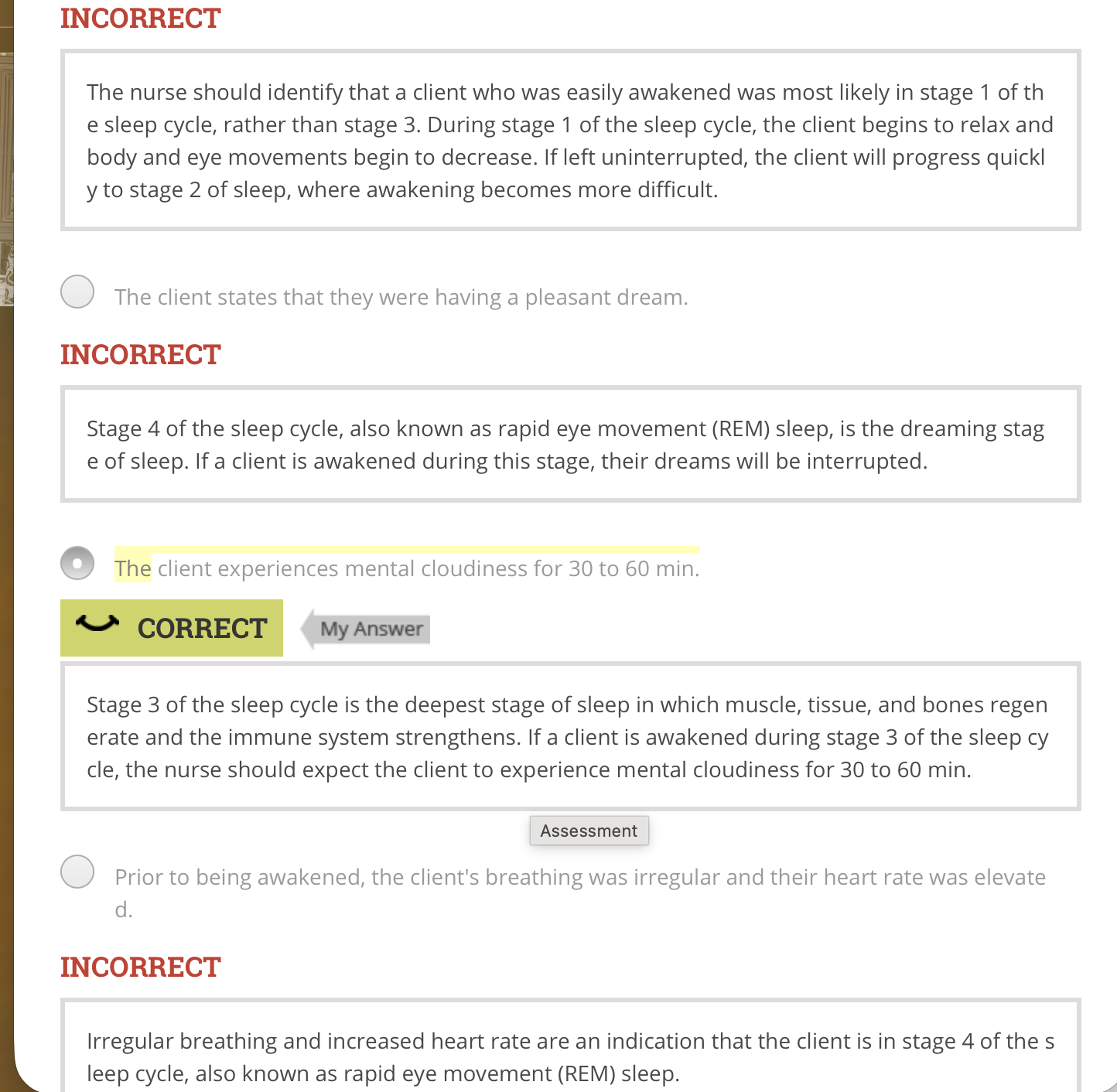
Question:
A nurse is caring for a client who has narcolepsy (NT1) with cataplexy. Th e nurse should identify that this condition is caused by a lack of which of the following hormones?
•
•
Hypocretin
Melatonin
Assessment
Estrogen
Insulin
Answer:
Hypocretin 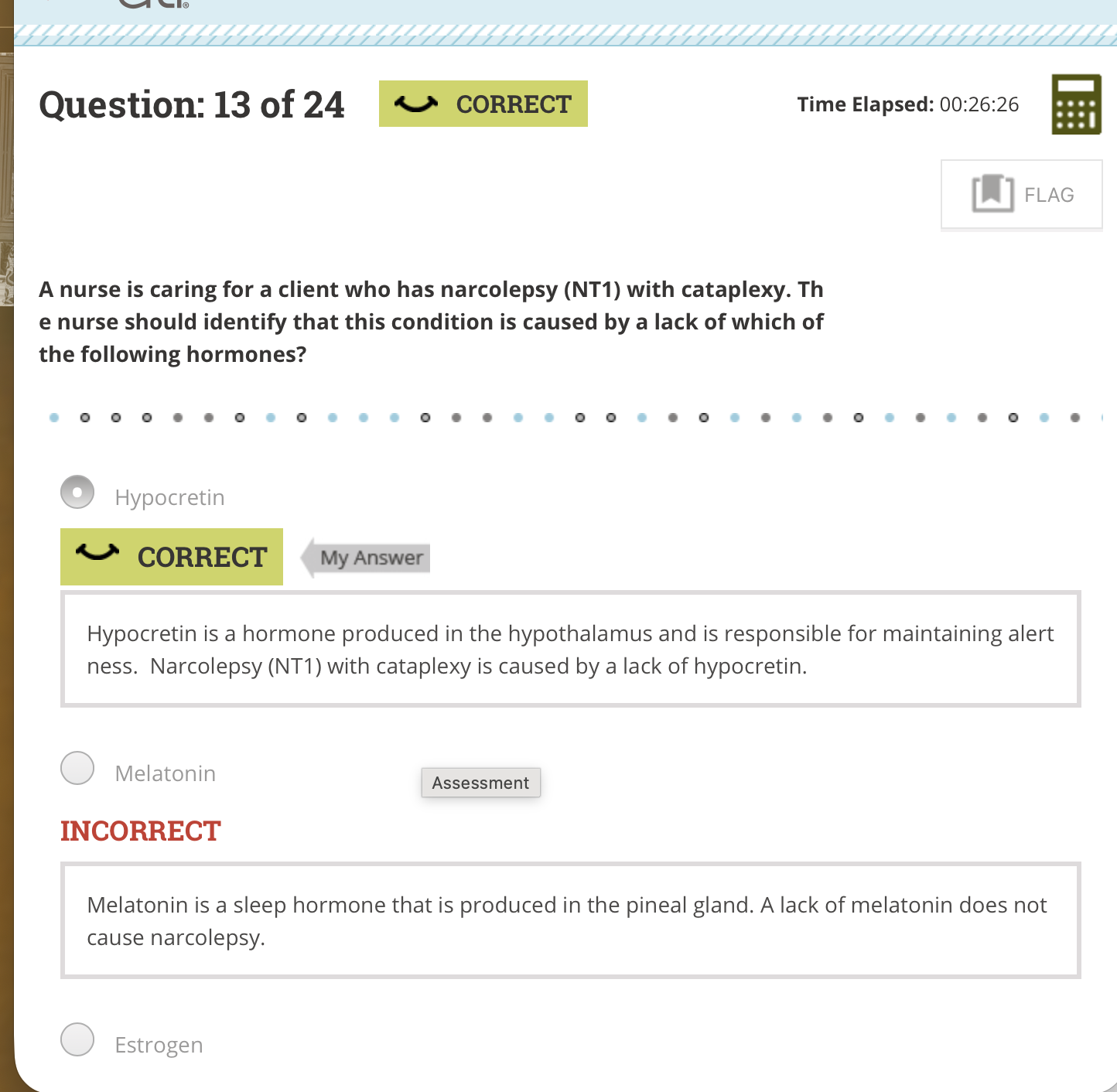
Question:
A nurse manager is conducting an in-service about the physiological funct ions of sleep for a group of staff nurses. Which of the following statement s by one of the nurses indicates an understanding of the teaching?
• °
"Sleep is a process that decreases the development of new neural pathways that assist with r etention of knowledge and memorization."
"The brain and neurons continue to communicate with each other during sleep to remove tox ins that built up in the brain while awak Assessment
"The circadian rhythm is an external process that controls the sleep-wake cycle."
"Clients experience the highest quality sleep when they complete three out of the four stages of sleep."
Answer:
✅ "The brain and neurons continue to communicate with each other during sleep to remove toxins that built up in the brain while awake." 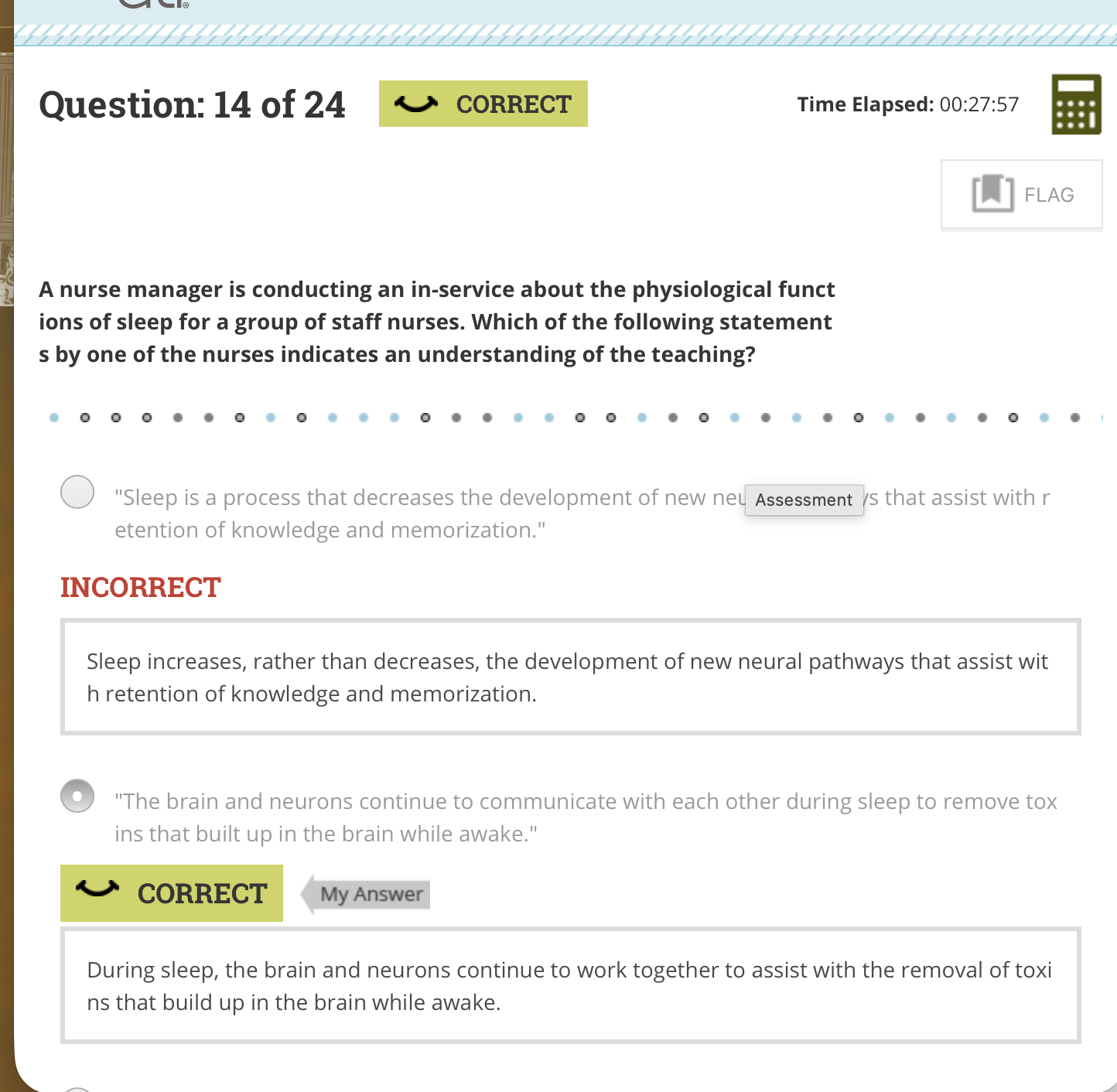
Question:
A nurse is planning care for a client who is postoperative. Which of the fol lowing interventions should the nurse plan to include to promote emotio nal comfort for the client?
Encourage the client to verbalize their needs and concerns.
Limit time spent with client.
Ask the client to splint the incision when coughing.
Assessment
Administer pain medications as prescribed.
Answer:
✔️ Encourage the client to verbalize their needs and concerns. 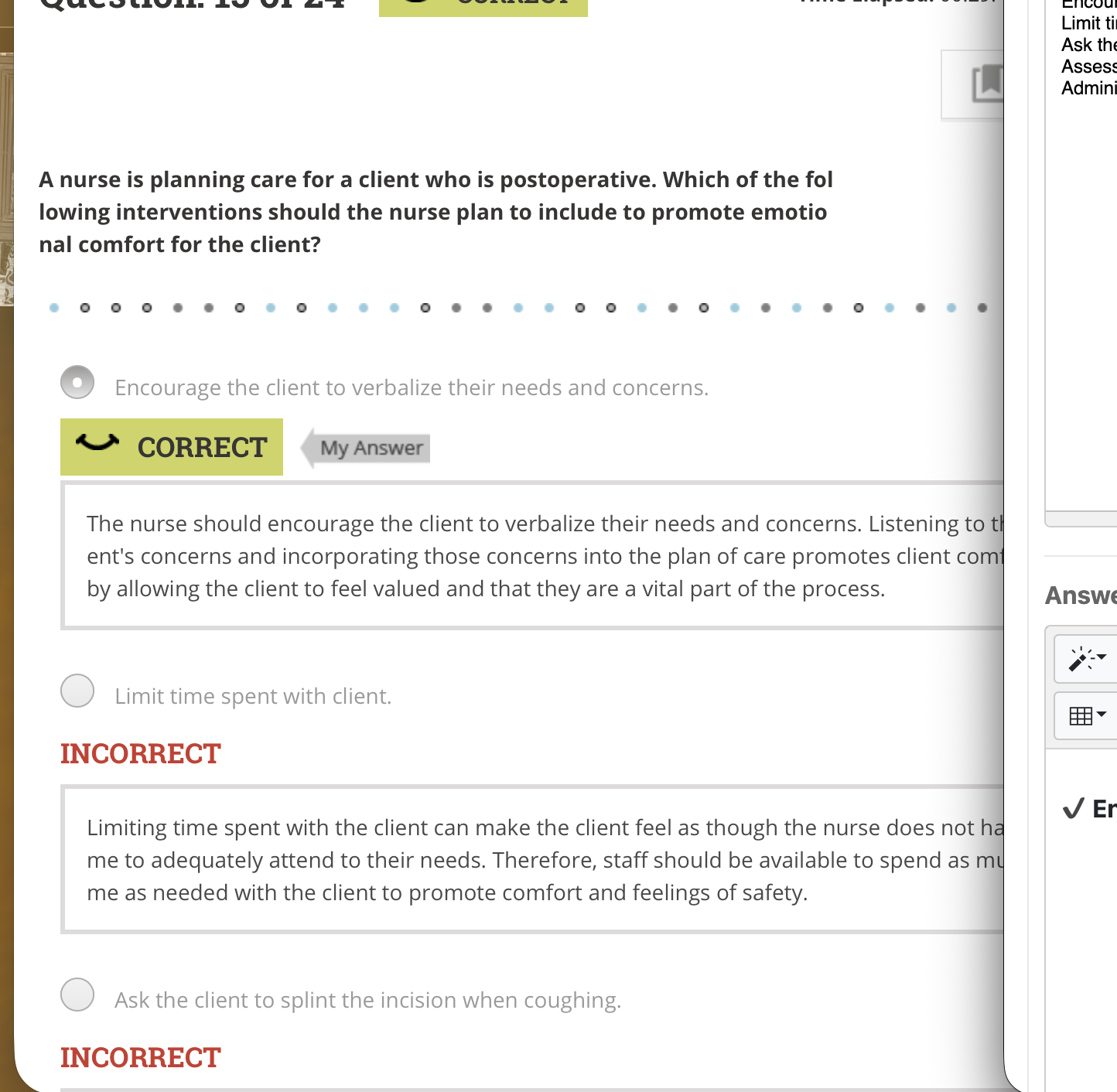
Question:
A nurse is caring for an older adult client who is having difficulty sleeping and has a new prescription for a medication to help them sleep. Which of the following medications should the nurse identify as a first-line sleep ai d for older adults?
Alprazolam
Eszopiclone
Assessment
Melatonin
Diphenhydramine
Answer:
Melatonin 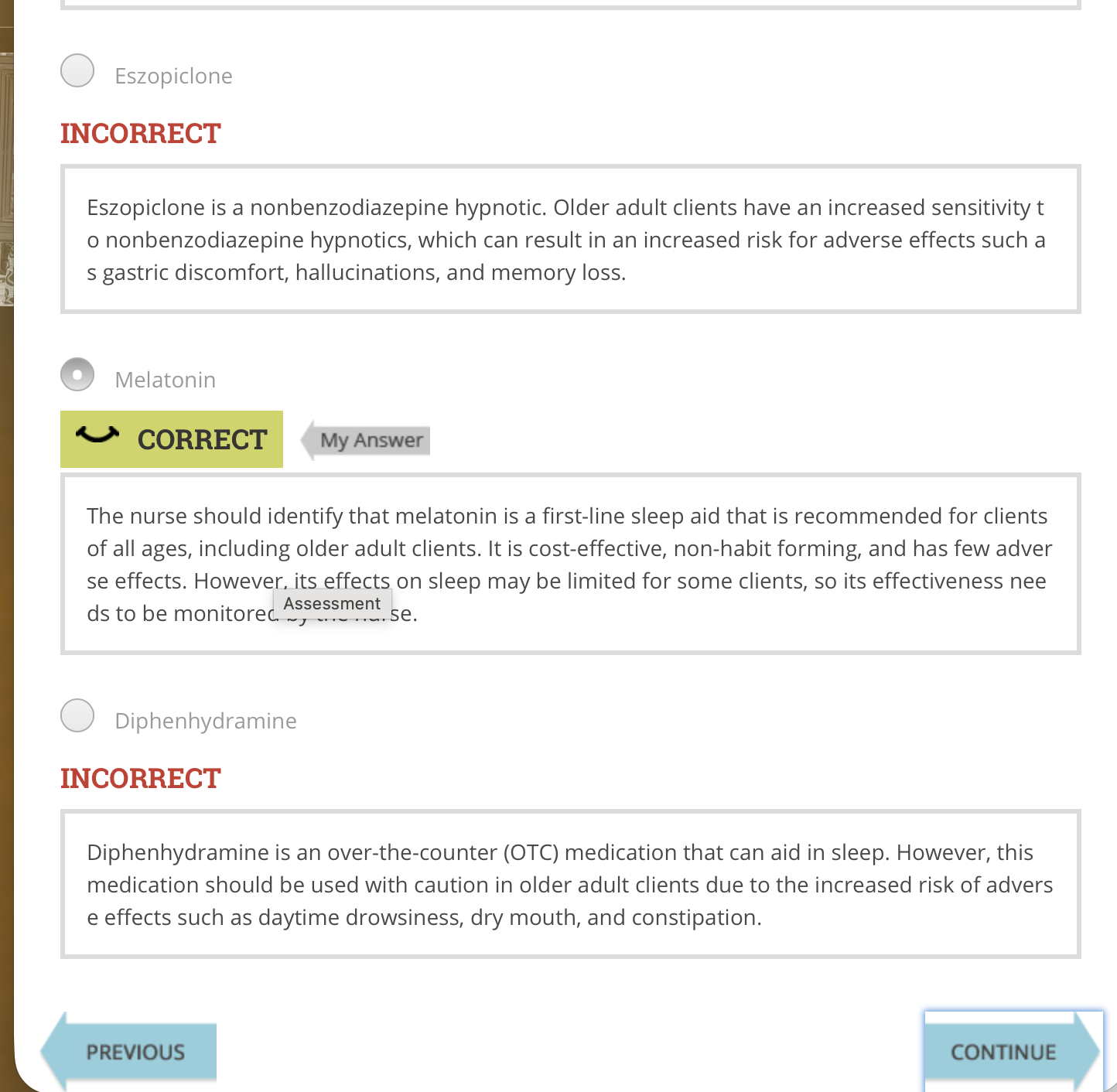
Question:
A nurse is reviewing the concept of comfort with an assistive personnel ( AP). Which of the following statements by the AP indicates an understanding of comfort?
"Providing comfort for a client is achieved by the relief of physical pain through the administration of medication."
"Providing comfort to a client involves alleviating the client's physical, mental, and emotional distress using warmth and empathy."
"Providing comfort for a client is achieved by taking control of the client's care and creating routines for the client to become familiar with."
"Providing comfort to a client requires staff members to smile and remain cheerful no matter the outcome the client is facing."
Answer:
✔️ "Providing comfort to a client involves alleviating the client's physical, mental, and emotional distress using warmth and empathy." 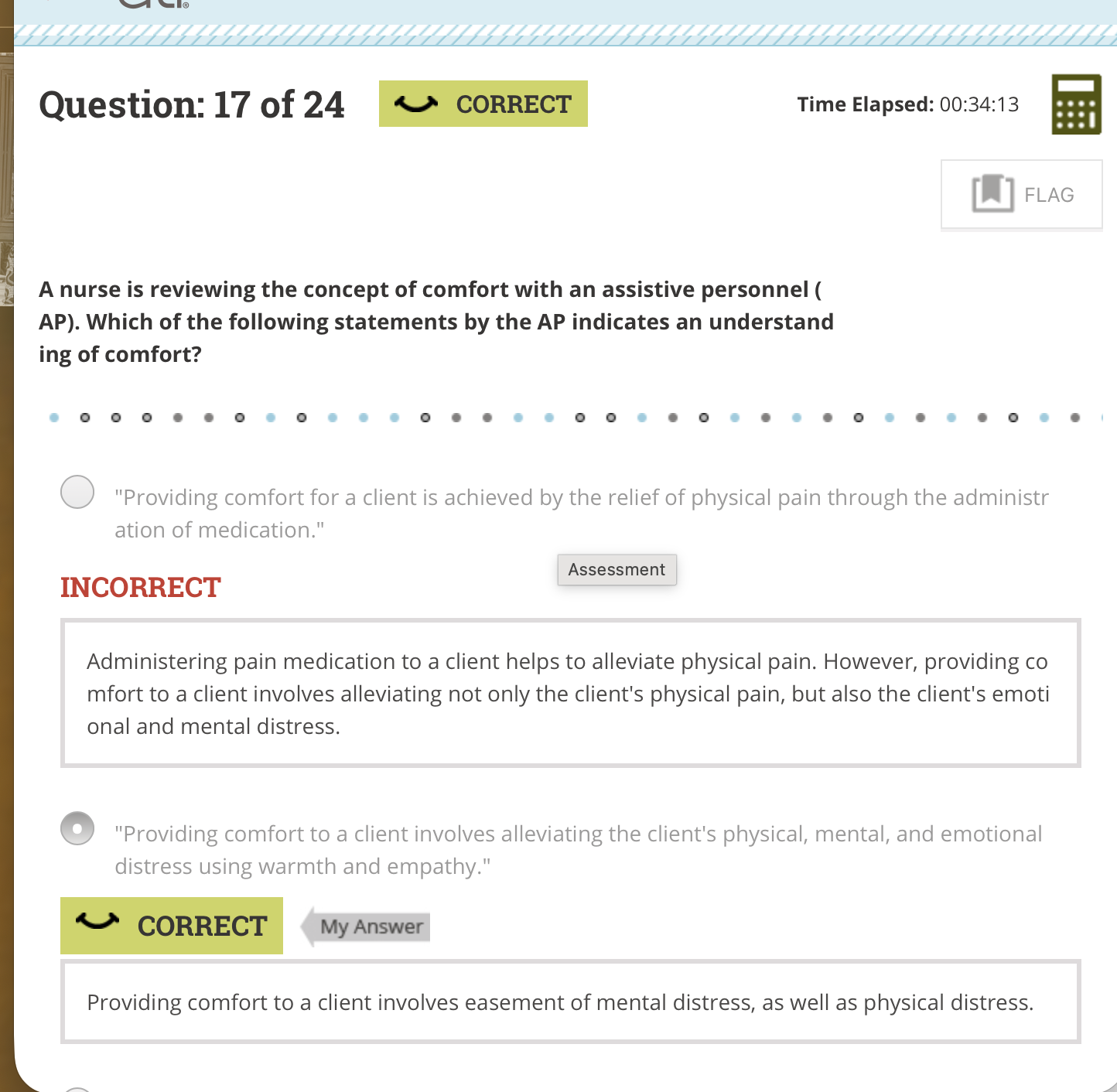
Question:
A nurse is caring for a client who was admitted following a report of lumb ar pain. In addition to administering pain medications, which of the following interventions should the nurse implement to promote comfort?
Present information honestly.
Have another nurse present difficult information.
Do not include the client's concerns in the plan of care if they interfere with treatment.
Perform cognitive behavioral therapy with the client.
Answer:
✔️ Present information honestly. 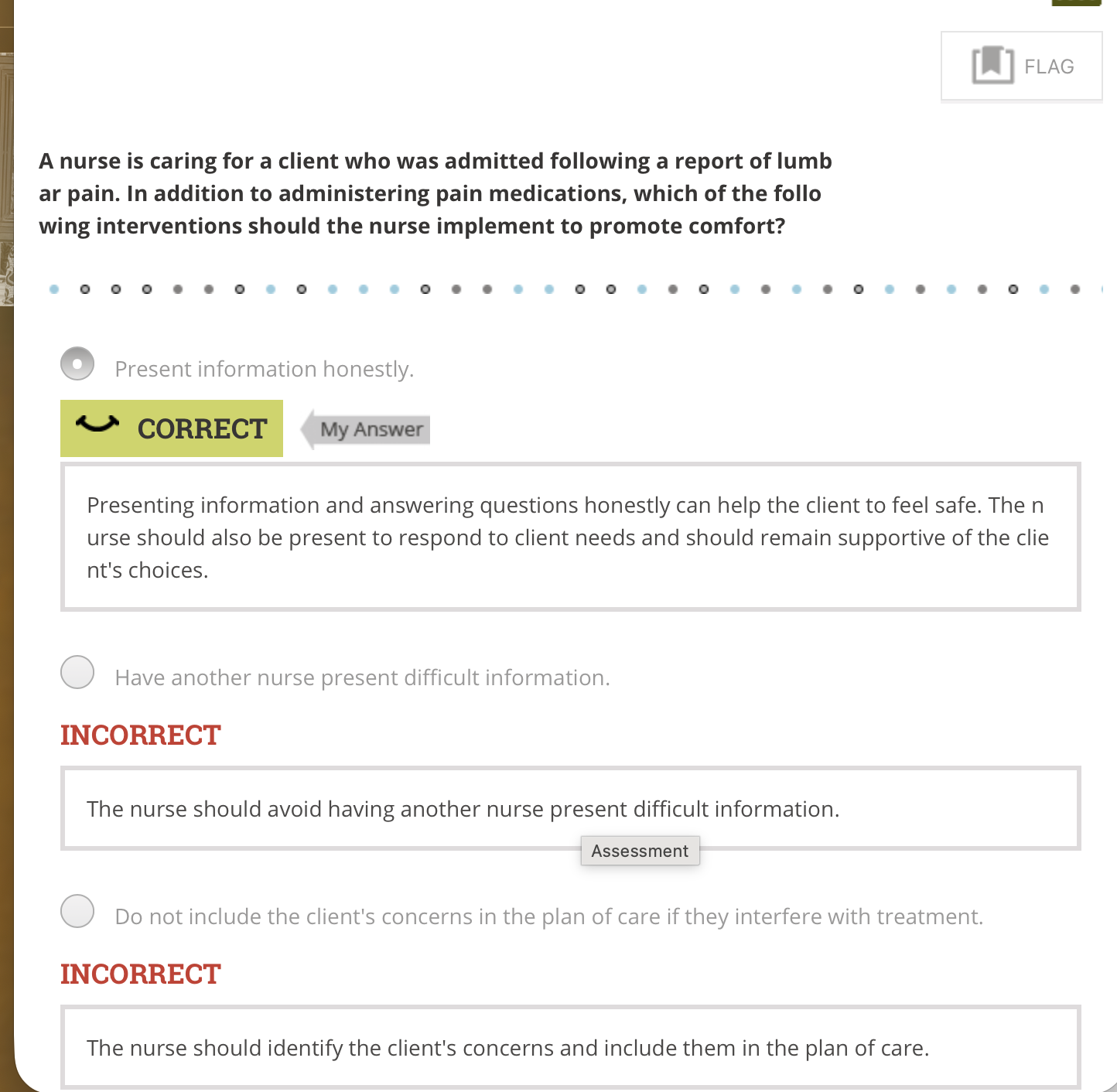
Question:
A nurse is caring for a client who is having difficulty falling asleep. Which of the following interventions should the nurse implement to promote sle ep for the client?
Offer the client a caffeinated beverage 3 hr before their bedtime.
Turn on the client's television before they go to bed.
Warm the temperature of the client's room before they go to bed.
Dim the lights in the client's room at bedtime.
Answer:
✔️ Dim the lights in the client's room at bedtime.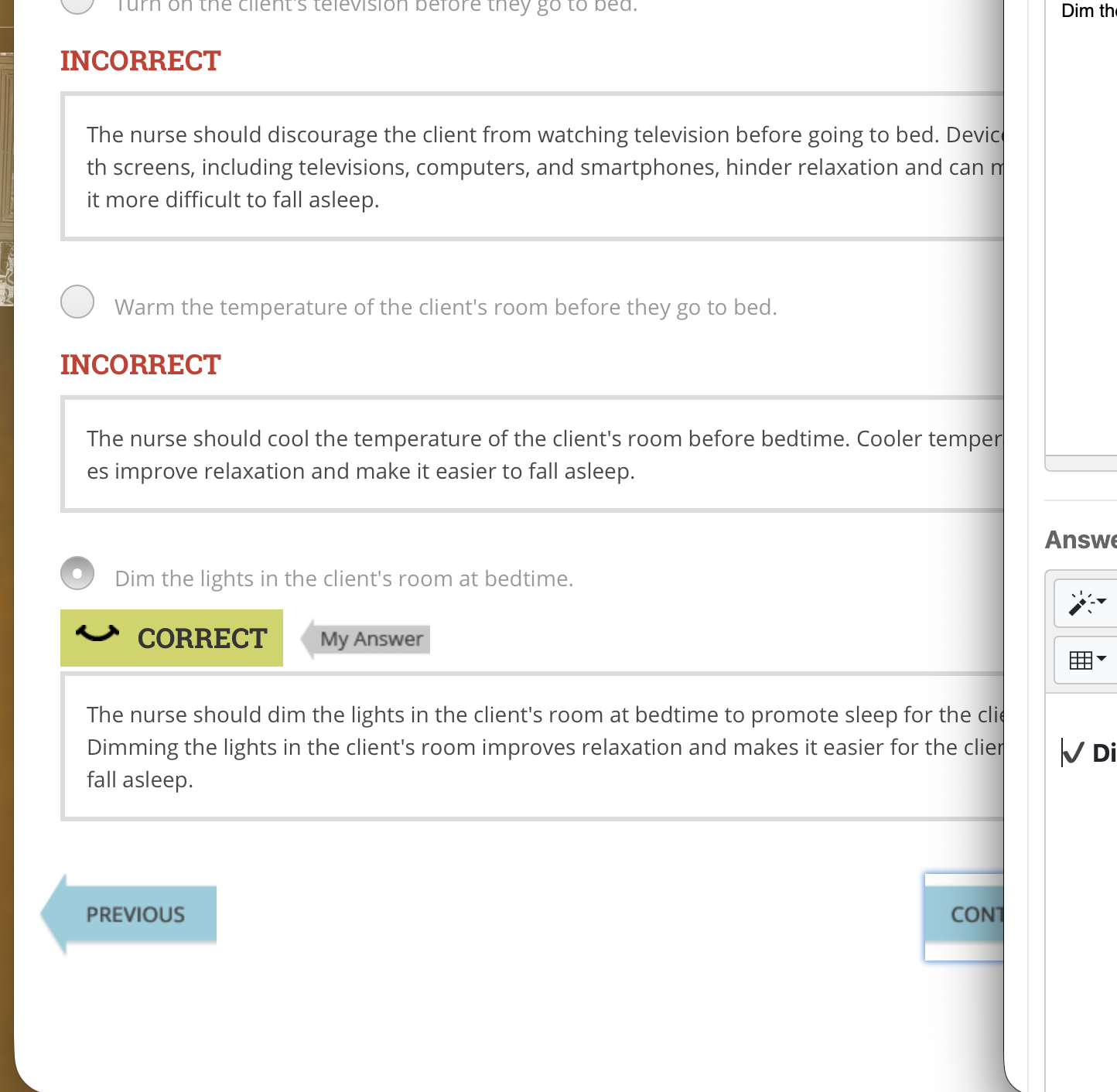
Question:
A nurse is evaluating a client after measures to promote comfort have be en implemented. Which of the following statements by the client indicate s that the client has been comforted?
"I wish the staff would listen closer to my needs."
"I am concerned about what is going to happen during my tests tomorrow."
Assessment
"It seems to take the staff a while to answer the call light."
"My health care team has helped me to feel safe during my stay."
Answer:
✔️ "My health care team has helped me to feel safe during my stay." 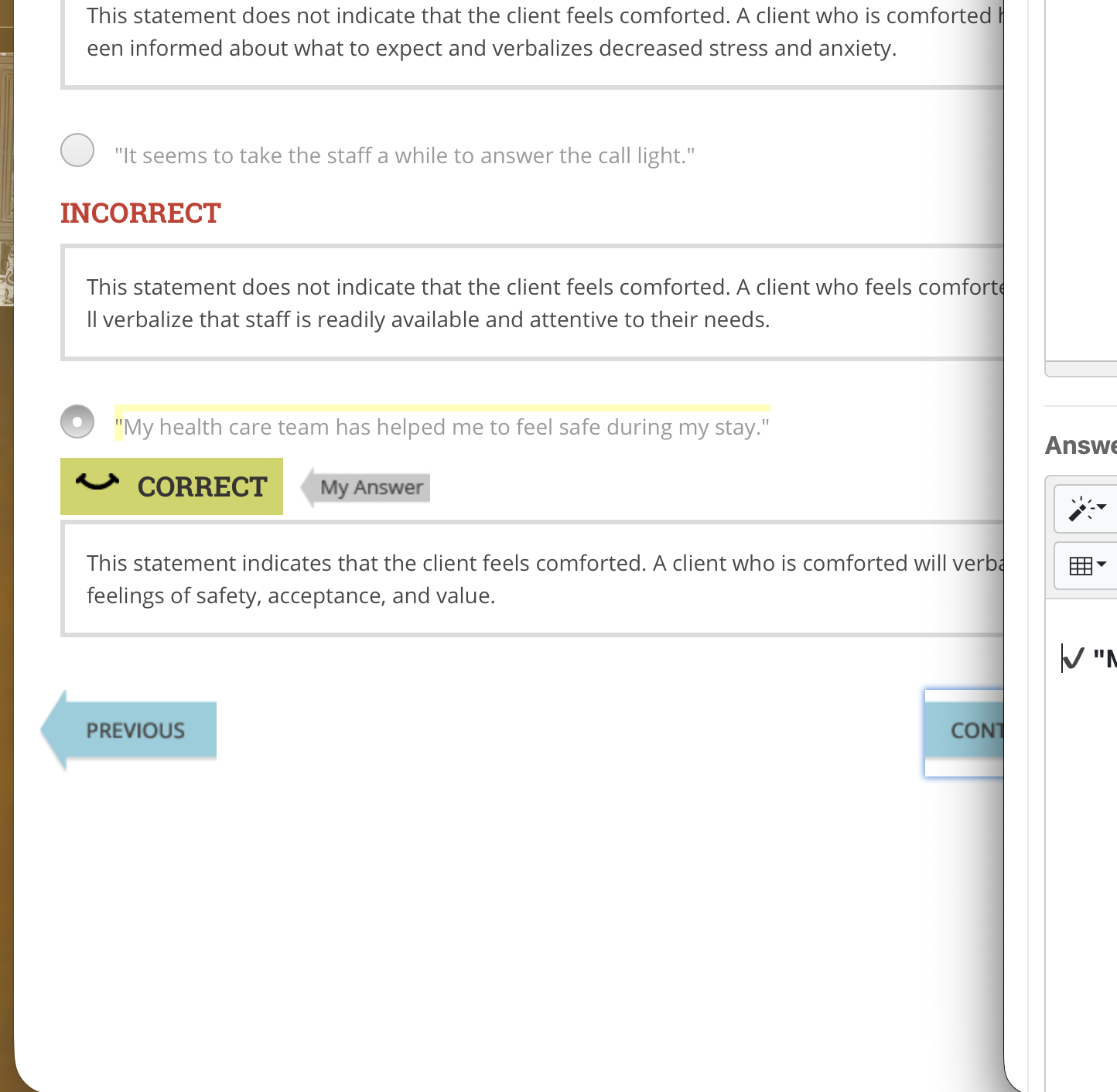
Question:
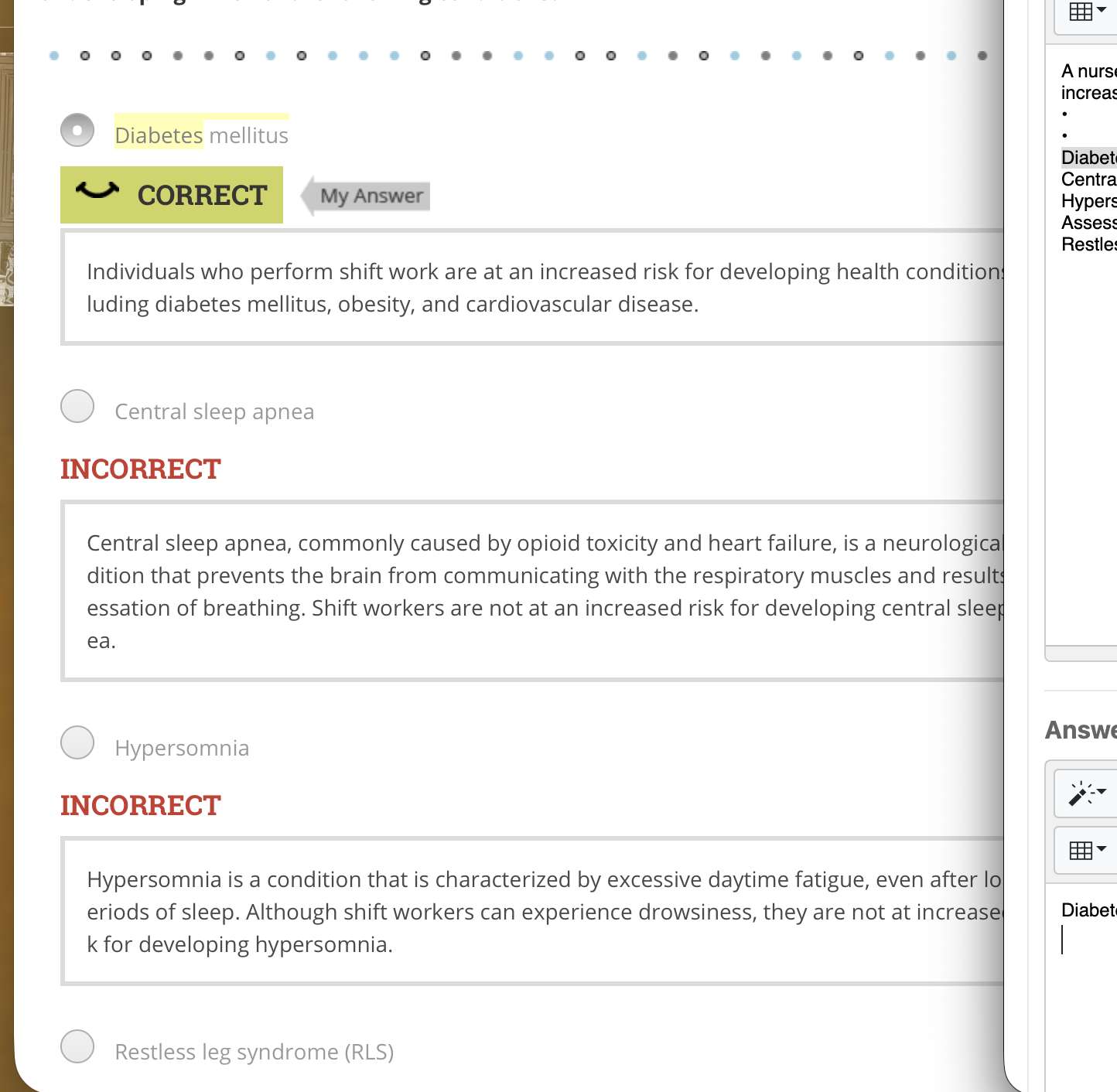
A nurse is caring for a client who works overnight shifts. The nurse should identify that individuals who perform shift work are at an increased risk f or developing which of the following conditions?
•
•
Diabetes mellitus
Central sleep apnea
Hypersomnia
Assessment
Restless leg syndrome (RLS)
Answer:
Diabetes mellitus
Question:
A nurse is discussing the stages of the sleep cycle with a client. The nurse should include that the immune system is strengthened and tissues and bones are repaired during which of the following stages of the sleep cycle?
°
...
Assessment
Stage 1
Stage 2
Stage 3
Stage 4
Answer:
Stage 3 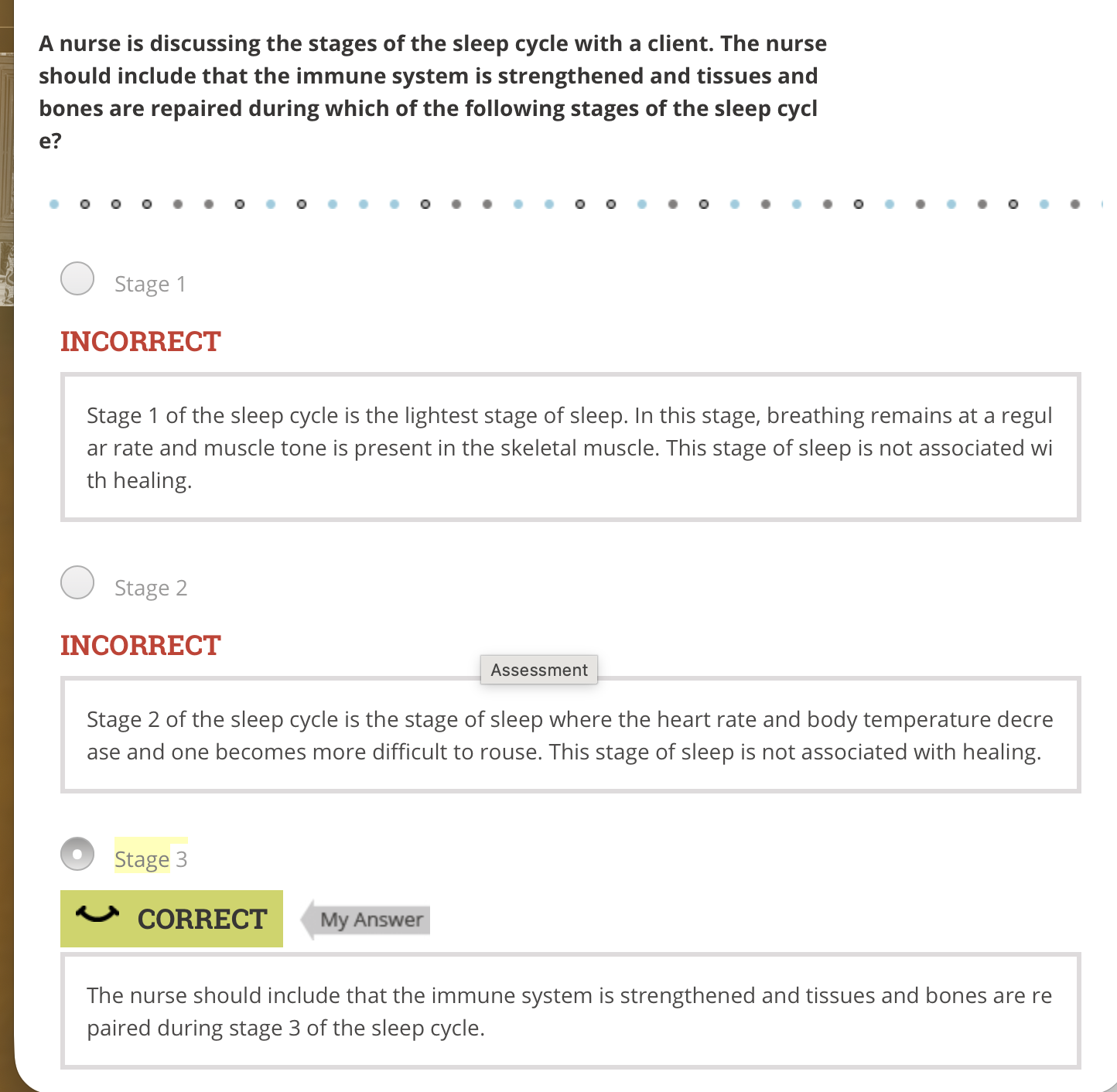
Question:
A nurse is reviewing the plan of care for a client who was admitted with i nsomnia and recent weight gain. Which of the following is a benefit of inc reased sleep that could help prevent further weight gain for the client?
•
Increased ghrelin production
Increased leptin production
Decreased hypocretin levels
• Decreased melatonin levels
Answer:
✔️ Increased leptin production 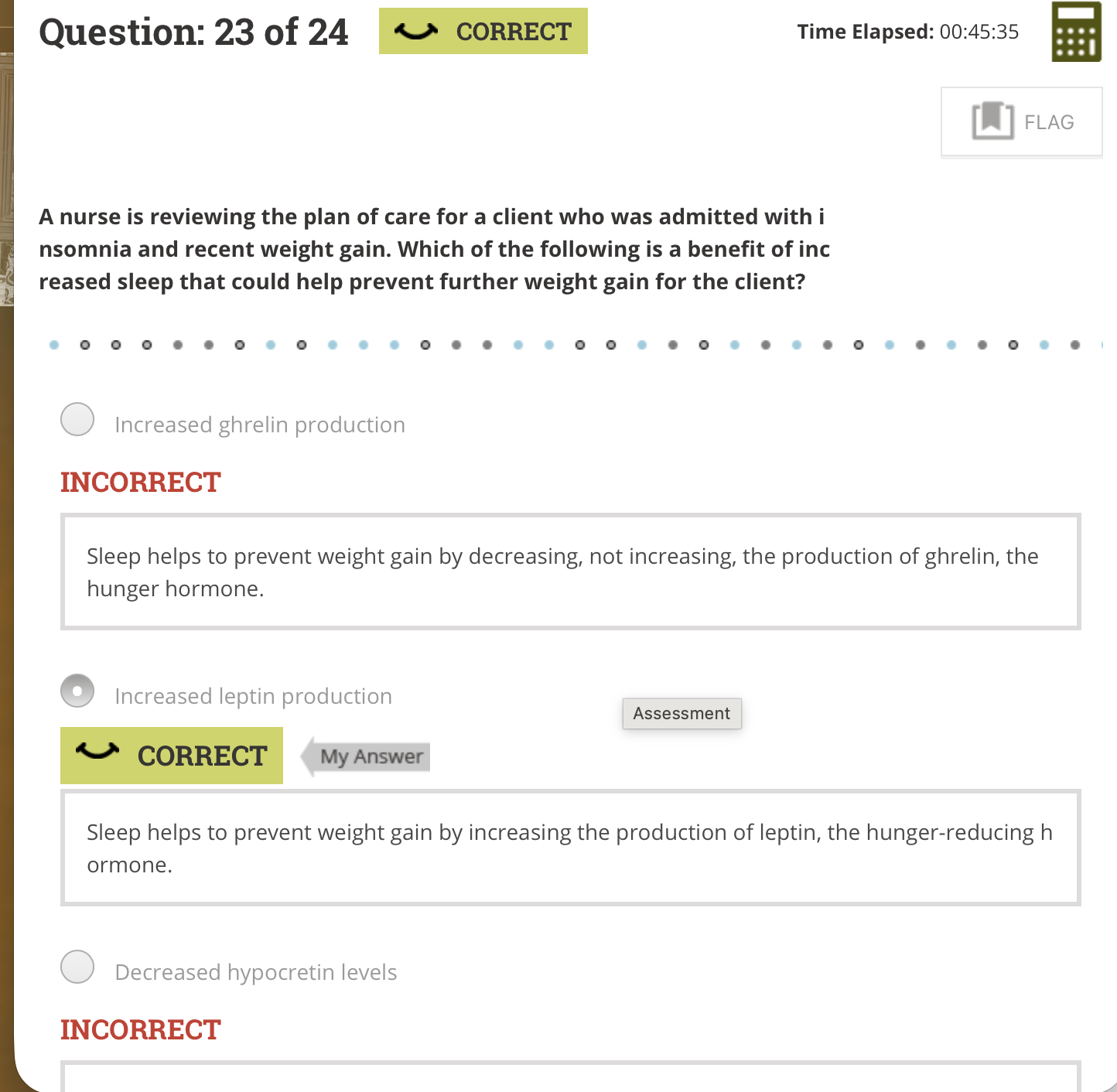
Question:
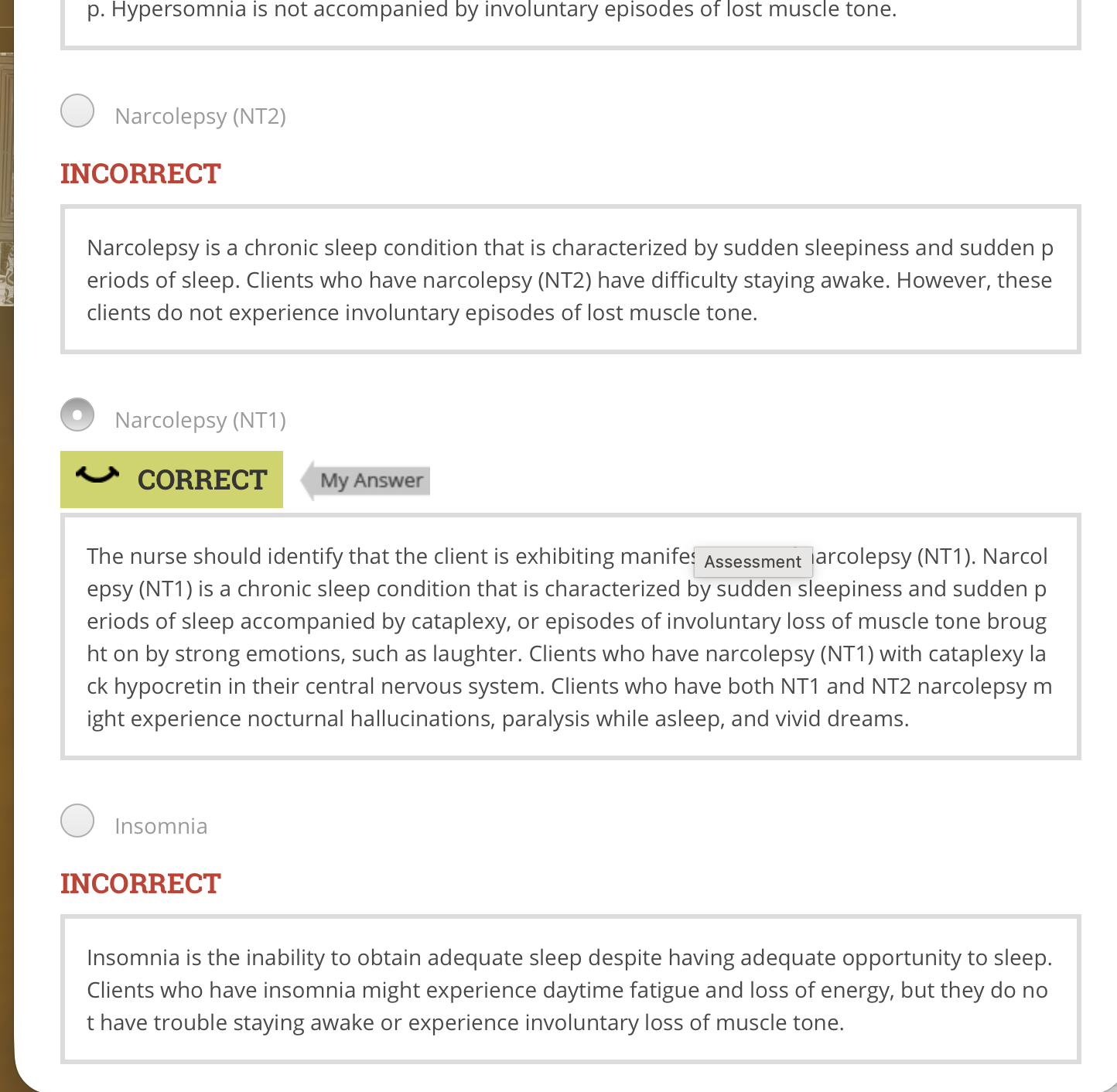
A nurse is assessing a client who reports difficulty staying awake during t he day and experiencing involuntary episodes of lost muscle tone. The nu rse should identify that these are manifestations of which of the followin g conditions?
Hypersomnia
Narcolepsy (NT2)
Narcolepsy (NT1)
Insomnia
Answer:
Narcolepsy